HetaSep™

For depletion of red blood cells from fresh blood samples and isolation of nucleated cells
HetaSep™

For depletion of red blood cells from fresh blood samples and isolation of nucleated cells

From: 130 USD
Catalog #
(Select a product)
For depletion of red blood cells from fresh blood samples and isolation of nucleated cells
Add to Wish List

Overview

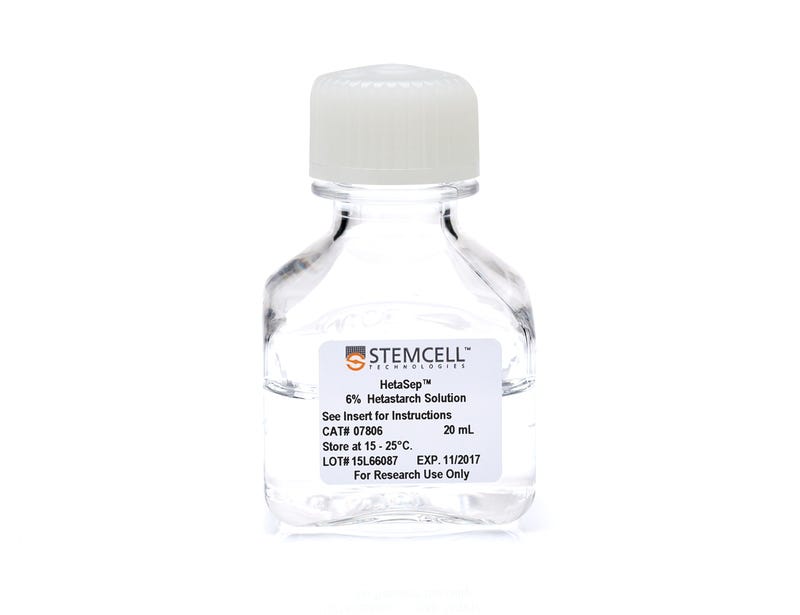
HetaSep™ is an erythrocyte aggregation agent used to quickly separate nucleated cells from red blood cells (RBCs) in whole blood. Aggregated erythrocytes settle much faster than dispersed cells. By controlling the settling time and/or centrifugation speed, the majority of nucleated cells are recovered in the supernatant. Approximately 95 - 99% RBC depletion is attained if the nucleated cell-rich fraction is removed carefully. HetaSep™ contains 6% w/v hetastarch.
Magnet Compatibility
 
Subtype
Cell Isolation Kits
Cell Type
Granulocytes and Subsets, Leukocytes, Red Blood Cells
Species
Human
Sample Source
Cord Blood, Whole Blood
Selection Method
Negative
Application
Cell Isolation
Brand
HetaSep
Area of Interest
Immunology, Stem Cell Biology

Protocols and Documentation

Find supporting information and directions for use in the Product Information Sheet or explore additional protocols below.

Document Type
Product Name
Catalog #
Lot #
Language
Product Name
HetaSep™
Catalog #
07906
Lot #
All
Language
English
Document Type
Safety Data Sheet
Product Name
HetaSep™
Catalog #
07906
Lot #
All
Language
English

Applications

This product is designed for use in the following research area(s) as part of the highlighted workflow stage(s). Explore these workflows to learn more about the other products we offer to support each research area.

Resources and Publications

Publications (11)

An NMR Metabolomics Analysis Pipeline for Human Neutrophil Samples with Limited Source Material G. Filbertine et al. Metabolites 2025 Sep

Abstract

Background/Objectives: Untargeted 1H NMR metabolomics is a robust and reproducible approach used to study the metabolism in biological samples, providing unprecedented insight into altered cellular processes associated with human diseases. Metabolomics is increasingly used alongside other techniques to detect an instantaneous altered cellular function, for example, the role of neutrophils in the inflammatory response. However, in some clinical settings, blood samples may be limited, restricting the amount of cellular material available for a metabolomic analysis. In this study, we wanted to establish an optimal 1D 1H NMR metabolomic pipeline for use with human neutrophil samples with low amounts of input material. Methods: We compared the effect of different neutrophil isolation protocols on metabolite profiles. We also compared the effect of the absolute cell counts (100,000 to 5,000,000) on the identities of metabolites that were detected with an increasing number of scans (NS) from 256 to 2048. Results/Conclusions: The variance in the neutrophil profile was equivalent between the isolation methods, and the choice of isolation method did not significantly alter the metabolite profile. The minimum number of cells required for the detection of neutrophil metabolites was 400,000 at an NS of 256 for the spectra acquired with a cryoprobe (700 MHz). Increasing the NS to 2048 increased metabolite detection at the very lowest cell counts (<400,000 neutrophils); however, this was associated with a significant increase in the analysis time, which would be rate-limiting for large studies. The application of a correlation-reliability-score-filtering method to the spectral bins preserved the essential discriminatory features of the PLS-DA models whilst improving the dataset robustness and analytical precision.
LILRA5 Functions to Induce ROS Production on Innate Immune Cells Z. Fu et al. European Journal of Immunology 2025 Oct

Abstract

ABSTRACTActivating immune receptors provides mechanisms for phagocytes to elicit important effector functions that promote the killing of microbes. Leukocyte immunoglobulin‐like receptor A5 (LILRA5), an orphan immune receptor expressed by human phagocytes and co‐localising with FcRγ, remains poorly characterised. To address this, we developed a highly specific anti‐LILRA5 monoclonal antibody that has agonistic properties. We show LILRA5 expression on naïve monocytes and neutrophils, and that ligation of LILRA5 stimulates ROS production. While increased LILRA5 transcripts have been associated with sepsis, we also observed increased levels in patients with systemic infection but without sepsis complications. Ex vivo bacterial infection of whole blood did not alter surface LILRA5 expression, but LPS stimulation changed expression levels, indicating that surface LILRA5 expression is dynamic and likely regulated post‐transcriptionally, changing responses to different stimuli or over time. Soluble (s)LILRA5 was enhanced in sera from sepsis patients and in supernatants of monocytes that were LPS‐stimulated, indicating that shedding of LILRA5 from cell surfaces or that expression of sLILRA5 isoforms provides a mechanism to regulate surface LILRA5 expression levels. Finally, we show that altered surface LILRA5 expression influences LILRA5‐induced ROS production capacity. Thus, LILRA5 is a dynamically regulated activating receptor expressed on phagocytes that stimulates ROS production. Ligation of the activating LILRA5 receptor specifically stimulates ROS production by monocytes and neutrophils. Though LILRA5 transcripts are upregulated upon immune stimulation, surface LILRA5 expressions are dynamically regulated. Enhanced soluble LILRA5 was observed during immune challenge, suggesting that dynamic regulation of LILRA5 modulates ROS induction and innate immune responses.
Engineered neutrophil engagers overcome IgA limitations and reprogram resting neutrophils for cancer immunotherapy J. Lee et al. Journal of Biological Engineering 2025 Dec

Abstract

BackgroundBispecific antibodies that redirect T cells or NK cells to tumors have demonstrated substantial therapeutic efficacy, but their broader application is often constrained by immune-related toxicities, limited effector cell availability, and suboptimal access to tumor sites. These challenges have prompted efforts to identify alternative effector cell types that are more abundant in circulation, readily accessible, and capable of cytotoxic activity in the tumor microenvironment. Neutrophils, which constitute the most prevalent circulating leukocyte population, represent a promising yet underutilized target for immune cell engager design. However, efforts to exploit neutrophil-mediated tumor killing through CD89 (FcαRI) have been limited by the inherent drawbacks of IgA-based formats, including poor stability, short serum half-life, and reduced developability.ResultsTo address these challenges, we established an engineered bispecific antibody platform that incorporates CD89 engagement into an IgG1 scaffold. This design enables neutrophil redirection while preserving the favorable pharmacokinetic and manufacturing profiles of IgG-based therapeutics. The resulting bispecific architecture allows for programmable neutrophil engagement alongside tumor antigen recognition, offering a clinically viable strategy for innate immune activation. Among the bispecific designs evaluated, ZT-8, a humanized CD89 × HER2 bispecific antibody, demonstrated potent neutrophil-mediated cytotoxicity against tumor cells even in the absence of cytokine priming, suggesting a distinct activation mechanism that operates within the tumor microenvironment. Compared to IgA-based antibodies, ZT-8 exhibited superior immune effector engagement, enhanced tumoricidal activity, and substantially prolonged in vivo half-life through FcRn-mediated recycling.ConclusionThese findings define IgG-based CD89 bispecifics as a next-generation neutrophil engager platform and exemplify how antibody engineering and synthetic immunology can be leveraged to expand the effector landscape of bispecific immunotherapies.Supplementary InformationThe online version contains supplementary material available at 10.1186/s13036-025-00580-2.