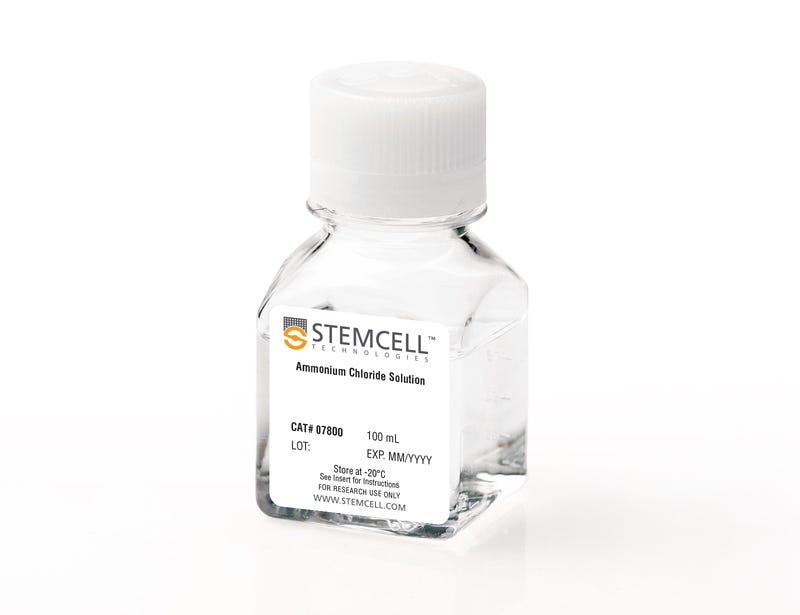
Ammonium Chloride Solution

Reagent for lysis of red blood cells

Ammonium Chloride Solution

Reagent for lysis of red blood cells
From: 37 USD
Catalog #
(Select a product)
Reagent for lysis of red blood cells
Add to Wish List

Overview

Ammonium Chloride Solution is recommended for the lysis of red blood cells (RBCs) in preparations of human and mouse peripheral blood, spleen, or bone marrow cells. It is buffered and optimized for gentle lysis of erythrocytes, with minimal effect on leukocytes. It does not contain a fixative agent, therefore leukocytes are viable following RBC lysis.
Contains
• 0.8% NH4Cl
• 0.1 mM EDTA in water, buffered with KHCO3 to achieve a final pH of 7.2 - 7.6
Species
Human, Mouse, Non-Human Primate, Other, Rat

Protocols and Documentation

Find supporting information and directions for use in the Product Information Sheet or explore additional protocols below.

Document Type
Product Name
Catalog #
Lot #
Language
Catalog #
07850, 07800
Lot #
All
Language
English
Document Type
Safety Data Sheet
Catalog #
07850, 07800
Lot #
All
Language
English

Applications

Resources and Publications

Publications (28)

Bile acids mediate liver-bone marrow crosstalk. D. Vitale et al. iScience 2026 Jul

Abstract

Disruption of liver metabolism alters immune responses, with maximal immune activation occurring when metabolic stress increases bone marrow hematopoietic stem cell (HSC) activity. We previously showed that sustained HSC activation enhances liver immune surveillance and reduces tumor burden. In the present study, we show that short-term HSC stimulation alone is insufficient for tumor control. Dietary supplementation with cholesterol and cholic acid, however, synergistically stimulates HSC responses and markedly elevates serum taurocholic acid (T-CA). Pharmacological inhibition of the apical sodium-dependent bile acid transporter (ASBT) restores bile acid homeostasis and lowers circulating T-CA, attenuating HSC activation and liver inflammation. Collectively, these findings reveal a bile acid-mediated liver-bone marrow crosstalk with direct implications for metabolic and neoplastic liver diseases.
Cumulative environmental exposures adversely impact social behaviour and are associated with dysregulation of genes and proteins involved in epigenetic, ribosomal, and immune regulation in male mice M. Bucknor et al. Inflammation Research 2026 Jan

Abstract

ObjectiveThis study investigated how cumulative environmental exposures influence offspring behaviour and inflammation-related molecular signatures in the brain and peripheral immune system.MethodsA novel "triple-hit" mouse model was developed using C57Bl/6JAusB mice (N = 70), combining preconceptual social stress, antenatal high-fat diet, and a postnatal immune challenge (poly(I:C), 10 mg/kg). At 12 weeks, offspring underwent behavioural tests relevant to neurodevelopmental disorders (NDDs), including the Elevated Plus Maze, 3-Chamber Social Preference, Self-Grooming, and Marble Burying. A composite NDD-risk index was calculated. Single-cell RNA sequencing (scRNA-seq) and bulk proteomics were performed on male triple-hit offspring to identify differentially expressed genes and proteins associated with inflammatory pathways.ResultsMale triple-hit offspring showed elevated NDD-related behavioural risk and social deficits, not observed in females. scRNA-seq revealed altered inflammatory and ribosomal pathways in brain glia and peripheral immune cells. Proteomic analysis showed decreased abundance of proteins involved in inflammation, translation, chromatin remodelling, and synaptic function in both brain and blood.ConclusionCombined environmental stressors may drive male-specific behavioural and inflammatory changes relevant to NDDs. The identification of overlapping inflammatory signatures in brain and peripheral immune cells supports a role for shared immune mechanisms in brain–immune axis dysfunction. However, these pathway-level findings should be interpreted as preliminary hypotheses and warrant independent validation to confirm their mechanistic significance.Supplementary InformationThe online version contains supplementary material available at 10.1007/s00011-025-02152-y.
Organoid models established from primary tumors and patient-derived xenograft tumors reflect platinum sensitivity of ovarian cancer patients P. Nikeghbal et al. BMC Cancer 2025 Sep

Abstract

BackgroundOvarian cancer (OC) remains the deadliest gynecological cancer, primarily due to late-stage diagnosis and high rates of chemotherapy resistance and recurrence. Lack of representative preclinical models complicate the challenges of discovering effective therapies, especially for platinum-resistant OC. Patient-derived xenograft (PDX) models maintain the genetic characteristics of the original tumor and are ideal for testing candidate therapies in vivo, but their high cost limits their feasibility for high-throughput drug screening. Organoid models mimic the tumor’s 3D structure and preserve intra-tumoral heterogeneity. While organoids established directly from primary patient tumors are the optimal model for personalized drug response studies, the supply of primary tissue is often limited. Patient-derived xenograft tumors can be passaged in mice and provide a renewable source of cancer cells for organoids. This study aimed to determine if PDX-derived organoids (PDXOs) can reflect patient responses to chemotherapy similarly to primary patient-derived organoids (PDOs).Methods3D Organoid models were established from the malignant ascites of five high grade serous ovarian cancer patients: two platinum-sensitive, two platinum-resistant, and one platinum-refractory, along with their matched PDX samples from ascites and solid tumor. Organoid viability after 72-hour treatment with paclitaxel (PTX), carboplatin (CBDCA), or their combination was compared between organoids derived directly from the patient or from the PDX models. The in vitro drug responses of PDXOs and PDOs were then compared to defined patient clinical responses: platinum-sensitive (initial response to standard platinum/paclitaxel therapy lasting > 6 months post-treatment), platinum-resistant (initial response to standard chemotherapy lasting < 6 months), or platinum-refractory (no initial response to standard chemotherapy).ResultsIn drug response assays, PDXOs and PDOs demonstrated similar sensitivity to standard chemotherapy and also reliably reflected patient responses based on the clinical designation of platinum sensitivity. While organoids derived from the ascites were smaller with a denser morphology, their drug response mirrored that of the organoids derived from solid tumor. Platinum-sensitive cases exhibited significant reductions (around 50% reduction) in organoid viability when treated with carboplatin, paclitaxel, or their combination. Platinum-resistant or refractory organoids showed little to no reduction in viability with carboplatin or paclitaxel monotherapy or the combination. Organoids derived from one platinum-resistant case did show a small but significant reduction in viability with single-agent paclitaxel, suggesting that organoid models might predict response to second-line paclitaxel therapy.ConclusionThis study demonstrates that PDXOs respond to drugs similarly to PDOs and confirms that both models effectively mirror patient response to standard chemotherapy. This highlights the potential of PDXOs as renewable models for screening novel therapies and developing personalized strategies in OC.Supplementary InformationThe online version contains supplementary material available at 10.1186/s12885-025-14811-8.