
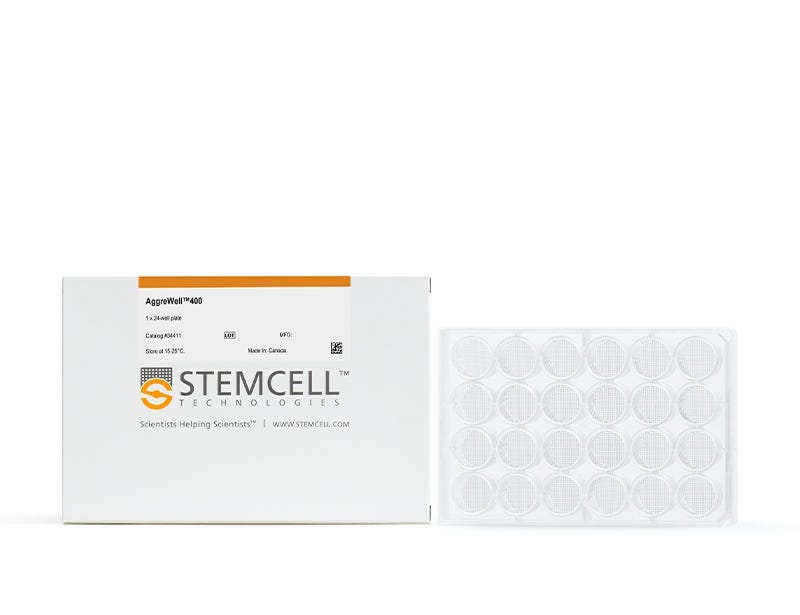
AggreWell™400
Microwell culture plates for easy and reproducible production of embryoid bodies and spheroids
Products for Your Protocol
To see all required products for your protocol, please consult the
Protocols and Documentation.
-
 Anti-Adherence Rinsing Solution
Rinsing solution for cultureware to prevent cell adhesion
Overview
Protocols and Documentation
Find supporting information and directions for use in the Product Information Sheet or explore additional protocols below.
Applications
This product is designed for use in the following research area(s) as part of the highlighted workflow stage(s). Explore these workflows to learn more about the other products we offer to support each research area.
Resources and Publications
Educational Materials (13)


Publications (31)
Effect of xeroderma pigmentosum group C on the characteristics and regulatory mechanisms of lung cancer stem cells.
International journal of oncology 2026 Oct
Abstract
Lung cancer is one of the most common and deadly forms of cancer worldwide, with >80% of cases being non‑small cell lung cancer. Its recurrence and drug resistance have been major challenges in clinical treatment, posing a serious threat to the lives of patients. The present study found that high xeroderma pigmentosum group C (XPC) expression markedly reduced the proliferation capacity and stem cell characteristics of the lung cancer cell lines A549‑XPC and H460‑XPC. In addition, XPC overexpression led to a decreased in the proportion of cells in the G2/M phase proportion, suggesting alterations in the cell cycle process. MTS assays showed that XPC overexpressing cells demonstrated markedly higher sensitivity to chemotherapy drugs compared with control cells. Furthermore, the clonogenic and anchorage‑independent spheroid formation capacities of the cells were markedly inhibited with high XPC expression and the phosphorylation levels of the JAK/STAT pathway and the expression levels of stemness‑associated markers were markedly altered. In vivo studies validated the effect of high XPC expression on tumorigenicity using a subcutaneous tumor model, with tumor volumes of 134.04±46.77 mm³ and 324.64±85.31 mm³ and weights of 164.24±76.16 mg and 434.70±115.72 mg for subcutaneously injected A549‑XPC and A549‑CTR cells, respectively. High expression of XPC in the A549 cells significantly affected tumor volume (P<0.05) and weight (P<0.01) in vivo. The present findings suggested that high XPC expression is associated with reduced proliferation, migration and stem cell‑like properties in lung cancer cells, enhances their sensitivity to chemotherapy drugs and suppresses tumor growth in vivo. These observations supported further investigation of XPC as a potential therapeutic target and prognostic marker for lung cancer, offering new strategies to improve treatment outcomes and prolong patient survival.
Unconventional auricular reconstruction using controlled scaffold buckling and chondrogenic cocktail containing muscle-derived cells.
Bioactive materials 2026 Nov
Abstract
Tissue engineered auricles face challenges such as subpar graft mechanical robustness, insufficient stem/progenitor cells, and unidentified factors that specifically promote elastic cartilage. To tackle these, we developed resilient and bioactive 3D-printed scaffolds using two unconventional concepts, including controlled buckling compliant lattices for mechanical resilience and muscle-derived stem/progenitor cells (MDSCs) with defined biochemical factors for facile elastic cartilage-like regeneration. Our functionally graded design reduced stress by 63.1% relative to other graded designs, which was validated by finite element analysis and high-magnitude compressive testing. Notably, 91.7% of scaffolds remained undamaged in stark contrast to 100% failure for clinically-used MEDPOR® and 76.5% failure for other graded scaffolds. Further, we developed an elastic auricular regenerative cocktail (EARc) comprised of abundantly available MDSCs and elastic cartilage-specific biochemical factors. In vitro, mouse, and rabbit studies confirmed that EARc scaffolds facilitated mechanical resilience and elastic cartilage-like regeneration. In conclusion, EARc scaffolds demonstrate the unconventional application of buckling and muscle sourcing to enhance mechanical resilience and elastic-like cartilage-specific regeneration for auricular reconstruction.
Generation of apical-out nasal organoids to facilitate human respiratory syncytial virus infection and drug screening.
iScience 2026 Jul
Abstract
The nasal epithelium is the first respiratory epithelium that is exposed to inhaled airborne pathogens. As a result, it is crucial to model host-pathogen interactions occurring in this tissue. To facilitate the efficient modeling of these interactions, we have developed a method to generate de novo apical-out nasal organoids from nasal epithelial cell aggregates. Optimization of this method revealed a stark tissue-specific effect of the culture temperature, as organoids were generated in much higher efficiency at 32.5°C compared to more widely used temperatures of 37°C. These organoids recapitulate the native tissue cellular composition of ciliated, basal, and goblet cells, while maintaining high homogeneity in size. Functionally, the system demonstrates susceptibility to viral infection and provides a robust platform for modeling antiviral drug responses. This standardized approach offers a reproducible system with high potential to be utilized in host-pathogen interaction studies and personalized medicine.
Related Products
Related Products


Quality Statement:
PRODUCTS ARE FOR RESEARCH USE ONLY AND NOT INTENDED FOR HUMAN OR ANIMAL DIAGNOSTIC OR THERAPEUTIC USES UNLESS OTHERWISE STATED. FOR ADDITIONAL INFORMATION ON QUALITY AT STEMCELL, REFER TO WWW.STEMCELL.COM/COMPLIANCE.
PRODUCTS ARE FOR RESEARCH USE ONLY AND NOT INTENDED FOR HUMAN OR ANIMAL DIAGNOSTIC OR THERAPEUTIC USES UNLESS OTHERWISE STATED. FOR ADDITIONAL INFORMATION ON QUALITY AT STEMCELL, REFER TO WWW.STEMCELL.COM/COMPLIANCE.
