ImmunoCult™ Human CD3/CD28 T Cell Activator

Human T cell activation and expansion reagent

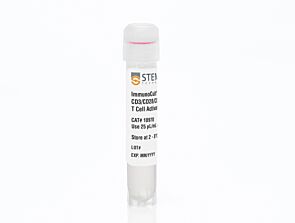
ImmunoCult™ Human CD3/CD28 T Cell Activator

Human T cell activation and expansion reagent
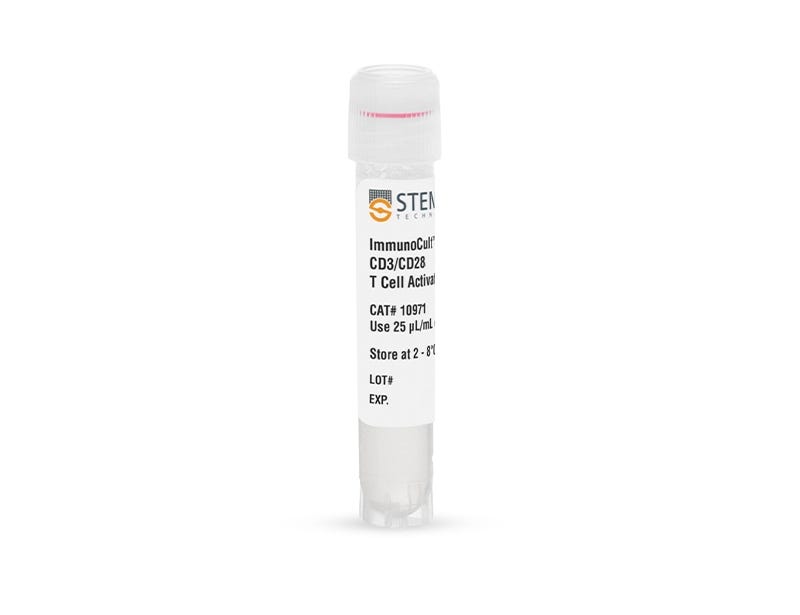
From: 209 USD
Catalog #
(Select a product)
Human T cell activation and expansion reagent
Add to Wish List

Product Advantages


  • Robust activation and expansion of human T cells without the use of magnetic beads, feeder cells, or antigen

  • Provides a gentle activation stimulus that maintains high viability of activated and expanded T cells

  • Highly stable, filter-sterilized soluble reagent

What Our Scientist Says

We want to make it easier to activate and expand human T cells while still maintaining a high viability of these cells. That's why we developed ImmunoCult™ Human CD3/CD28 T Cell Activator.

Jessie YuScientist
Jessie Yu, Scientist

Overview

Achieve robust activation and expansion of T cells in the absence of magnetic beads, feeder cells, or antigens.

This product’s gentle activation stimulus ensures a high viability of activated T cells, which can be further expanded in ImmunoCult™-XF T Cell Expansion Medium (Catalog #10981) or other media for culturing human T cells. Antibody complexes bind to and cross-link CD3 and CD28 cell surface ligands, thereby providing the required signals for T cell activation. ImmunoCult™ Human CD3/CD28 T Cell Activator can be used on the Seahorse XF Analyzer to measure T cell activation response and is also available as part of the Agilent Seahorse XF Hu T Cell Activation Assay Kit.

This product is designed for research applications. If you require reagents suitable for use in cell therapy manufacturing, ImmunoCult™ Human CD3/CD28 T Cell Activators (Catalog #100-0784) are produced under relevant GMPs.
Contains
• Anti-human CD3 monospecific antibody complex
• Anti-human CD28 monospecific antibody complex
Subtype
Supplements
Cell Type
T Cells, T Cells, CD4+, T Cells, CD8+
Species
Human
Application
Activation, Cell Culture, Expansion
Brand
ImmunoCult
Area of Interest
Immunology, Cell Therapy Development

Data Figures

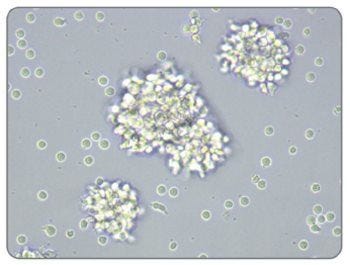
Activated Morphology of Human T Cells Stimulated With ImmunoCult™ Human CD3/CD28 T Cell Activator

Figure 1. Activated Morphology of Human T Cells Stimulated With ImmunoCult™ Human CD3/CD28 T Cell Activator

Image of human T cells isolated using the EasySep™ Human T Cell Isolation Kit (Catalog #17951), stimulated with ImmunoCult™ Human CD3/CD28 T Cell Activator, and cultured in ImmunoCult™-XF T Cell Expansion Medium (Catalog # 10981).

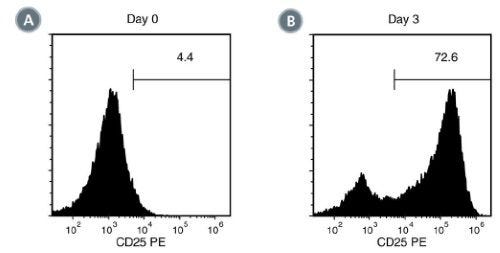
Activation of Human T Cells stimulated With ImmunoCult™ Human CD3/CD28 T Cell Activator

Figure 2. Activation of EasySep™-isolated Human T Cells stimulated With ImmunoCult™ Human CD3/CD28 T Cell Activator

EasySep™-isolated human T cells were stimulated with ImmunoCult™ Human CD3/CD28 T Cell Activator and cultured in ImmunoCult™-XF T Cell Expansion Medium. Activation of viable CD3+ T cells was assessed by CD25 expression using flow cytometry. On day 0, the frequency of CD25 positive cells was (A) 5.6 ± 2.4% (mean ± SD). Following 3 days of culture, the frequency of CD25 positive cells was (B) 75.4 ± 13.8% (mean ± SD) when stimulated with ImmunoCult™ Human CD3/CD28 T Cell Activator.

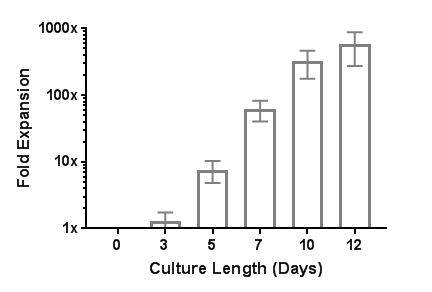
Robust Human T Cell Expansion with ImmunoCult™ Human CD3/CD28 T Cell Activator

Figure 3. Robust Human T Cell Expansion with ImmunoCult™ Human CD3/CD28 T Cell Activator

EasySep™-isolated human T cells were expanded over 12 days with ImmunoCult™ Human CD3/CD28 T Cell Activator in ImmunoCult™-XF T Cell Expansion Medium supplemented with Human Recombinant IL-2. On day 0, 1 x 10^6 EasySep™-isolated human T cells were stimulated with 25 μL of ImmunoCult™ Human CD3/CD28 T Cell Activator in ImmunoCult™-XF T Cell Expansion Medium supplemented with 10 ng/mL Human Recombinant IL-2. On days 3, 5, 7, and 10, viable cells were counted and fresh medium supplemented with IL-2 was added. No additional ImmunoCult™ Human CD3/CD28 T Cell Activator was added during the 12-day culture period (mean ± SD in 6 experiments with 3 donors).

Protocols and Documentation

Find supporting information and directions for use in the Product Information Sheet or explore additional protocols below.

Document Type
Product Name
Catalog #
Lot #
Language
Catalog #
10971, 10991
Lot #
All
Language
English
Document Type
Safety Data Sheet
Catalog #
10971, 10991
Lot #
All
Language
English

Applications

This product is designed for use in the following research area(s) as part of the highlighted workflow stage(s). Explore these workflows to learn more about the other products we offer to support each research area.

Resources and Publications

Educational Materials (21)

Publications (45)

Discovery of novel disulfide-containing PD-1/PD-L1 inhibitor with in vivo influenza therapeutic efficacy Y. Hirata et al. Scientific Reports 2025 Sep

Abstract

Monoclonal antibody-based immune checkpoint inhibitors, which have brought breakthrough effects in cancer treatments, are expected to assist in the treatment of viral diseases. However, antibody therapies may cause immune-related side effects, such as inflammation and pneumonia, due to cytokine storms. Small-molecule PD-1/PD-L1 inhibitors are an alternative to monoclonal antibody-based therapeutics. We have identified a novel small-molecule PD-1/PD-L1 inhibitor having a functional group (disulfide group), namely compound 2 (molecular weight: 456.6), from our library of sulfur-containing protein–protein interaction inhibitor compounds. Compound 2 selectively bound to PD-L1 over PD-1, with the dissociation rate constant (K D ) of 77.60 ± 4.44 nM (obtained by affinity analysis) and showed promising T cell activation recovery. A molecular docking simulation study between 2 and PD-L1 suggested that 2 binds to PD-L1 in a binding mode different from those of other small-molecule PD-L1/PD-1 inhibitors. Notably, oral administration of 2 to mice pre-infected with influenza A virus (A/NWS/33, H1N1 subtype) caused a significant increase in the neutralizing antibody titers, as well as recovery from influenza-induced pneumonia. Overall, 2 provides insight for the development of therapeutic drugs against early viral infections, with both virus titer-reducing and antibody titer-boosting effects. Moreover, 2 is widely used as a rubber peptizing agent in the production process of tires and other rubber products. Our findings may provide useful information for investigating its influence on living organisms. The online version contains supplementary material available at 10.1038/s41598-025-17982-3. Subject terms: Drug discovery and development, Pharmacology, Screening, Structure-based drug design
Transition from manual to automated processes for autologous T cell therapy manufacturing using bioreactor with expandable culture area J. S. Z. Lee et al. Scientific Reports 2025 May

Abstract

Transition from the manual processes that are performed during the initial research and development (R&D) stage to automated processes for later and commercial stage cell therapy manufacturing can be challenging. It often requires significant effort, time, and costs – which hinders the therapy’s access to the clinic. To ease this transition, we have developed a novel and flexible manufacturing platform, Bioreactor with Expandable Culture Area (BECA), that aims to support both R&D and manufacturing to accelerate cell therapies from bench to bedside. This report introduces two models in this manufacturing platform: BECA-S for manual small-scale operation at R&D phase and BECA-Auto for functionally closed and automated scaled-out operation at manufacturing phase. We employed these two models to streamline transition of the T cell culture process from manual to automated and reported insignificant differences in the culture outcome between the two. Our work represents the first detailed development and demonstration of a standalone cell manufacturing platform that facilitates a seamless transition between manual and automated processing for autologous T cell therapy manufacturing.
Expression of an interleukin-2 partial agonist enhances regulatory T cell persistence and efficacy in mouse autoimmune models J. Robert et al. Nature Communications 2025 May

Abstract

Regulatory T (Treg)-based cell therapy holds promise for autoimmune and inflammatory diseases, yet challenges remain regarding the functional stability and persistence of transferred Tregs. Here we engineer Tregs to express a partial agonist form of IL-2 (IL-2pa) to enhance persistence while avoiding toxicity from excessive signaling. Mouse Tregs expressing wild-type IL-2 (Tregs-IL2wt) have only a transient growth advantage, limited by toxicity from likely excessive signaling. By contrast, mouse Tregs-IL2pa exhibit sustained expansion, long-term survival in immunocompetent mice for over a year, and bystander expansion of endogenous Tregs. Tregs-IL2pa maintain a stable activated phenotype, Treg-specific demethylation, and a diverse TCR repertoire. In vivo, prophylactic transfer of Tregs-IL2pa ameliorates multi-organ autoimmunity in a Treg depletion-induced mouse autoimmune model. Lastly, compared with control Treg, human Tregs-IL2pa show enhanced survival in the IL-2-depleted environment of immune-deficient mice and improved control of xenogeneic graft-versus-host disease. Our results thus show that IL-2pa self-sufficiency enhances the stability, durability and efficacy of Treg therapies in preclinical settings. Subject terms: Cell delivery, Regulatory T cells, Autoimmune diseases, Interleukins