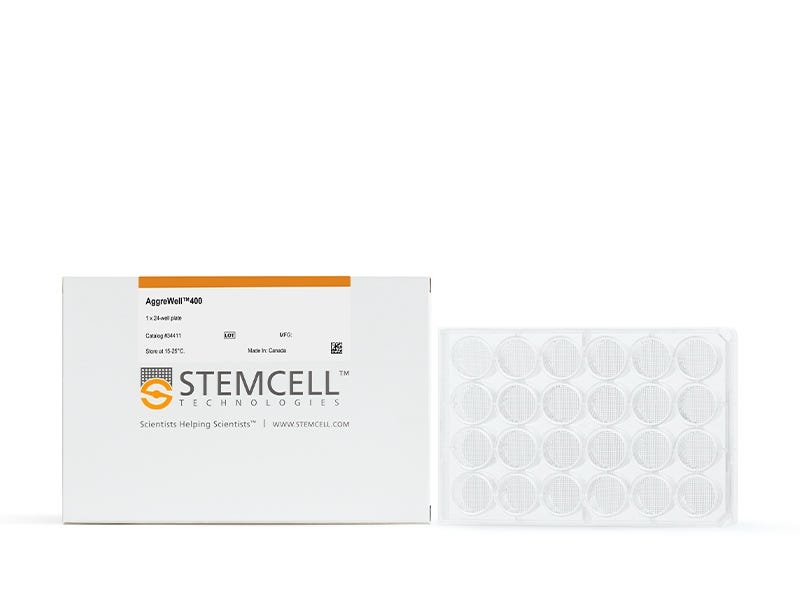
AggreWell™400
Microwell culture plates for easy and reproducible production of embryoid bodies and spheroids
Overview
Protocols and Documentation
Find supporting information and directions for use in the Product Information Sheet or explore additional protocols below.
Applications
This product is designed for use in the following research area(s) as part of the highlighted workflow stage(s). Explore these workflows to learn more about the other products we offer to support each research area.
Resources and Publications
Educational Materials (13)
Publications (29)
Unconventional auricular reconstruction using controlled scaffold buckling and chondrogenic cocktail containing muscle-derived cells.
Bioactive materials 2026 Nov
Abstract
Tissue engineered auricles face challenges such as subpar graft mechanical robustness, insufficient stem/progenitor cells, and unidentified factors that specifically promote elastic cartilage. To tackle these, we developed resilient and bioactive 3D-printed scaffolds using two unconventional concepts, including controlled buckling compliant lattices for mechanical resilience and muscle-derived stem/progenitor cells (MDSCs) with defined biochemical factors for facile elastic cartilage-like regeneration. Our functionally graded design reduced stress by 63.1% relative to other graded designs, which was validated by finite element analysis and high-magnitude compressive testing. Notably, 91.7% of scaffolds remained undamaged in stark contrast to 100% failure for clinically-used MEDPOR® and 76.5% failure for other graded scaffolds. Further, we developed an elastic auricular regenerative cocktail (EARc) comprised of abundantly available MDSCs and elastic cartilage-specific biochemical factors. In vitro, mouse, and rabbit studies confirmed that EARc scaffolds facilitated mechanical resilience and elastic cartilage-like regeneration. In conclusion, EARc scaffolds demonstrate the unconventional application of buckling and muscle sourcing to enhance mechanical resilience and elastic-like cartilage-specific regeneration for auricular reconstruction.
Generation of apical-out nasal organoids to facilitate human respiratory syncytial virus infection and drug screening.
iScience 2026 Jul
Abstract
The nasal epithelium is the first respiratory epithelium that is exposed to inhaled airborne pathogens. As a result, it is crucial to model host-pathogen interactions occurring in this tissue. To facilitate the efficient modeling of these interactions, we have developed a method to generate de novo apical-out nasal organoids from nasal epithelial cell aggregates. Optimization of this method revealed a stark tissue-specific effect of the culture temperature, as organoids were generated in much higher efficiency at 32.5°C compared to more widely used temperatures of 37°C. These organoids recapitulate the native tissue cellular composition of ciliated, basal, and goblet cells, while maintaining high homogeneity in size. Functionally, the system demonstrates susceptibility to viral infection and provides a robust platform for modeling antiviral drug responses. This standardized approach offers a reproducible system with high potential to be utilized in host-pathogen interaction studies and personalized medicine.
CRISPR-engineered human lung organoids with a biomolecular condensate reporter enable mechanistic toxicity monitoring
Materials Today Bio 2026 Feb
Abstract
Understanding how chemical stress perturbs human lung physiology requires models that capture dynamic molecular responses in real time. Here, we established a CRISPR/Cas9-engineered human induced pluripotent stem cell (hiPSC)-derived lung organoid expressing endogenous G3BP1–mCherry, enabling live, non-destructive visualization of stress granule (SG) formation under toxicant exposure. The organoids recapitulated airway and alveolar epithelial diversity and displayed lamellar body-like ultrastructures, indicating advanced maturation. Time-lapse imaging revealed rapid and reversible SG dynamics across chemically distinct stressors, while cytotoxicity assays showed that these organoids are significantly more sensitive than conventional 2D or cancer-derived lung models. Importantly, SG dynamics were linked to exposure duration–dependent changes in epithelial barrier integrity, indicating that SG formation precedes overt epithelial injury and serves as an early indicator of toxicant-induced cellular stress. Integration with high-content screening enabled quantitative, image-based analysis of cellular stress phenotypes, greatly enhancing throughput and mechanistic insight, thereby provided next-generation New Approach Methodologies for lung toxicity assessment. Together, this hiPSC-derived lung organoid SG reporter platform links early molecular stress adaptation to tissue-level responses, offering a predictive and mechanistically informative framework for human-relevant lung toxicity evaluation.
Quality Statement:
PRODUCTS ARE FOR RESEARCH USE ONLY AND NOT INTENDED FOR HUMAN OR ANIMAL DIAGNOSTIC OR THERAPEUTIC USES UNLESS OTHERWISE STATED. FOR ADDITIONAL INFORMATION ON QUALITY AT STEMCELL, REFER TO WWW.STEMCELL.COM/COMPLIANCE.