Hydrocortisone Stock Solution

Cell culture supplement

Hydrocortisone Stock Solution

Cell culture supplement
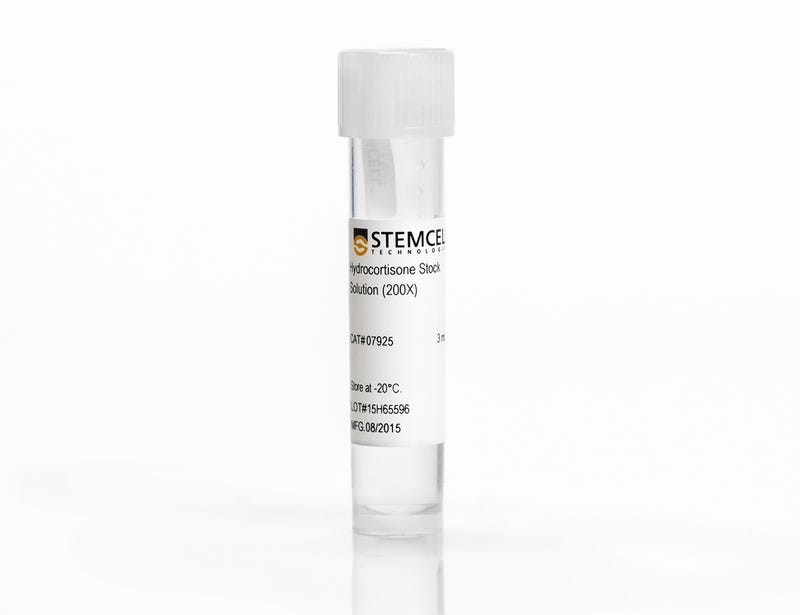
From: 35 USD
Catalog #
(Select a product)
Cell culture supplement
Add to Wish List

Product Advantages


  • Stock solution for convenient preparation of final cell culture media for PneumaCult™, MammoCult™, EpiCult™ and other media

Overview

Hydrocortisone Stock Solution is recommended for use as a cell culture supplement and for the preparation of PneumaCult™, MammoCult™, and EpiCult™ media when culturing airway epithelial cells, mammary primary cells, or tumor cell lines.

Hydrocortisone Stock Solution is provided at a concentration of 96 µg/mL, which is ideal as a 200X stock solution for use with PneumaCult™-ALI (Catalog #05001), MammoCult™ (Catalog #05620), EpiCult™-B (Human; Catalog #05601), and EpiCult™-C (Catalog #05630) media. It may also be used for preparing PneumaCult™-Ex Medium (Catalog #05008) or PneumaCult™-Ex Plus Medium (Catalog #05040).
Contains
• C₂₅H₃₃O₈Na (molecular weight: 484.5 g/mol) at a concentration of 2 x 10^-4 M
• Other ingredients
Subtype
Supplements
Cell Type
Airway Cells, Cancer Cells and Cell Lines, Mammary Cells, Other
Species
Human
Application
Cell Culture

Protocols and Documentation

Find supporting information and directions for use in the Product Information Sheet or explore additional protocols below.

Document Type
Product Name
Catalog #
Lot #
Language
Catalog #
07926, 07925
Lot #
All
Language
English
Document Type
Safety Data Sheet
Catalog #
07926, 07925
Lot #
All
Language
English

Applications

This product is designed for use in the following research area(s) as part of the highlighted workflow stage(s). Explore these workflows to learn more about the other products we offer to support each research area.

Resources and Publications

Educational Materials (1)

Publications (4)

Engineering Decellularized Extracellular Matrix-Incorporated Apical-Out Airway Organoids. Z. Gong et al. Bio-protocol 2026 Aug

Abstract

The airway epithelium interfaces with the external environment through its apical surface and with the extracellular matrix (ECM) through its basolateral surface. To model this organization in vitro, we developed a decellularized ECM-incorporated apical-out airway organoid (dECM-AoAO) platform in which human bronchial epithelial cells (HBECs) self-assemble around human lung-derived decellularized ECM microparticles (dECM-MPs). This configuration preserves apical-out polarity while enabling direct epithelial-ECM interactions. Here, we describe a protocol for the vacuum filtration and quantification of dECM-MPs, the generation of dECM-AoAOs, and ultimately, whole-mount immunofluorescence staining for organoid characterization. Key features • This protocol incorporates dECM as size-refined microparticles, enabling a consistent and reproducible ECM input. • The workflow uses suspension culture to generate apicalout airway organoids, eliminating the need for matrix embedding while preserving ECM-cell interactions. • dECM-MPs are directly wrapped by epithelial cells, simplifying handling and supporting native-like epithelial-ECM integration. • The system is compatible with wholemount immunofluorescence staining for comprehensive epithelial lineage analysis.
Isolation and Culture of Ferret Airway Stem Cells Z. Yan et al. Bio-protocol 2025 Jul

Abstract

Well-differentiated airway epithelial cultures are commonly used to study airway stem cell lineages, ion and fluid transport, respiratory virus infection and replication, and disease mechanisms in vitro. This culture model involves the isolation and expansion of airway stem cells followed by their differentiation at an air–liquid interface (ALI), a process that has been previously documented in humans and mice. Domestic ferrets (Mustela putorius furo) have gained considerable importance in respiratory disease research due to their notable susceptibility to these conditions and their anatomical similarities to humans. Here, we present a comprehensive description of the isolation and culture of stem/progenitor cells from the ferret airway, along with a protocol for their differentiation at the ALI. Our findings have demonstrated that this ferret culture system not only supports the differentiation of the predominant airway epithelial cell types but also facilitates the generation of rare airway epithelial subpopulations, including pulmonary ionocytes, tuft cells, and pulmonary neuroendocrine cells. Additionally, we provide a detailed procedure for measuring transepithelial ion transport relevant to airway diseases, particularly cystic fibrosis. The ability to isolate and culture ferret airway stem cells, combined with ALI differentiation and functional assessment of transepithelial ion transport, offers a powerful platform for evaluating genetic and pharmacologic interventions related to cystic fibrosis. Key features • A protocol for isolating ferret airway basal cells and generating air–liquid interface (ALI) cultures for electrophysiologic research.• Detailed procedures for propagating ferret airway basal cells and culturing in vitro well-differentiated airway epithelium.• A protocol for measuring ion transport, conductance, and immunofluorescence to identify airway cell types.
Dual RNA sequencing of a co-culture model of Pseudomonas aeruginosa and human 2D upper airway organoids C. Pleguezuelos-Manzano et al. Scientific Reports 2025 Jan

Abstract

Pseudomonas aeruginosa is a Gram-negative bacterium that is notorious for airway infections in cystic fibrosis (CF) subjects. Bacterial quorum sensing (QS) coordinates virulence factor expression and biofilm formation at population level. Better understanding of QS in the bacterium-host interaction is required. Here, we set up a new P. aeruginosa infection model, using 2D upper airway nasal organoids that were derived from 3D organoids. Using dual RNA-sequencing, we dissected the interaction between organoid epithelial cells and WT or QS-mutant P. aeruginosa strains. Since only a single healthy individual and a single CF subject were used as donors for the organoids, conclusions about CF-specific effects could not be deduced. However, P. aeruginosa induced epithelial inflammation, whereas QS signaling did not affect the epithelial airway cells. Conversely, the epithelium influenced infection-related processes of P. aeruginosa , including QS-mediated regulation. Comparison of our model with samples from the airways of CF subjects indicated that our model recapitulates important aspects of infection in vivo. Hence, the 2D airway organoid infection model is relevant and may help to reduce the future burden of P. aeruginosa infections in CF. The online version contains supplementary material available at 10.1038/s41598-024-82500-w.