Make more informed purchasing decisions with our new product availability and delivery estimate feature, now available on all product pages, in your cart, and during checkout.
Sign In
New to STEMCELL?
Register for an account to quickly and easily purchase products online and for one-click access to all educational content.
Thank you for your interest in this product.
Please provide us with your contact information and your local representative
will contact you with a customized quote. Where appropriate, they can also assist you with a(n):
Estimated delivery time for your area
Product sample or exclusive offer
In-lab demonstration
By submitting this form, you are providing your consent to STEMCELL Technologies Canada Inc. and its subsidiaries and affiliates (“STEMCELL”) to collect and use your information, and send you newsletters and emails in accordance with our privacy policy. Please contact us with any questions that you may have. You can unsubscribe or change your email preferences at any time.
Glial cell line-derived neurotrophic factor (GDNF) is a neurotrophic factor and a member of the tumor growth factor (TGF)-beta superfamily. The GDNF family of growth factors also includes neurturin, persephin, and artemin, which have seven conserved cysteine residues called cysteine-knots (Treanor et al.). GDNF family ligands signal through binding to specific GDNF-family receptor-α (GFRα) co-receptors and activate the RET receptor tyrosine kinase (Durbec et al.). Four different forms of GFRα co-receptors have been characterized (GFRα 1-4); GDNF binds specifically to GFRα1 prior to forming a complex with RET (Airaksinen & Saarma). GDNF is known to promote survival and morphological differentiation of midbrain dopaminergic neurons in both in vivo and in vitro studies and increases their high-affinity dopamine uptake (Granholm et al.; Lin et al.). GDNF has also been shown to have restorative effects on dying dopaminergic neurons in response to degenerative toxins (Aoi et al.). GDNF, together with Human Recombinant BDNF (brain-derived neurotrophic factor; Catalog #78005), BrainPhys™ Neuronal Medium (Catalog #05790), and other supplements, can be used to differentiate human pluripotent stem cell (hPSC)-derived neural progenitor cells into neurons (Bardy et al.).
Subtype
Cytokines
Cell Type
Neural Cells, PSC-Derived, Neural Stem and Progenitor Cells, Neurons
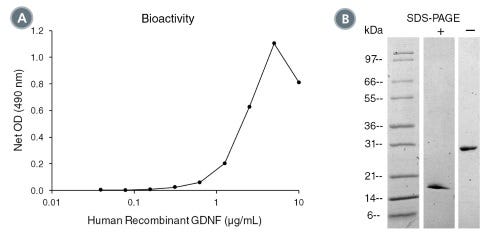
(A) The biological activity of Human Recombinant GDNF was tested by its ability to promote the proliferation of C6 cells. Cell proliferation was measured after 7 days of culture using a fluorometric assay method. The EC50 is defined as the effective concentration of the growth factor at which cell proliferation is at 50% of maximum. The EC50 in the example above is 2.17 μg/mL.
(B) 1 μg of Human Recombinant GDNF was resolved with SDS-PAGE under reducing (+) and non-reducing (-) conditions and visualized by Coomassie Blue staining. Human Recombinant GDNF is a homodimer of 15.2 kDa subunits with a predicted total molecular mass of 30.4 kDa.
This product is designed for use in the following research area(s) as part
of the highlighted workflow stage(s). Explore these workflows to learn more about the other products we
offer to support each research area.
STEMCELL TECHNOLOGIES INC.’S QUALITY MANAGEMENT SYSTEM IS CERTIFIED TO ISO 13485. PRODUCTS ARE FOR RESEARCH USE ONLY AND NOT INTENDED FOR HUMAN OR ANIMAL DIAGNOSTIC OR THERAPEUTIC USES UNLESS OTHERWISE STATED.