EasySep Human CD2 Positive Selection Kit II

Immunomagnetic positive selection of human CD2+ cells from PBMCs

EasySep Human CD2 Positive Selection Kit II

Immunomagnetic positive selection of human CD2+ cells from PBMCs

From: 841 USD
Catalog #
(Select a product)
Immunomagnetic positive selection of human CD2+ cells from PBMCs
Add to Wish List

Product Advantages


  • Fast and easy-to-use

  • Up to 97% purity

  • No columns required

What's Included

  • EasySep™ Human CD2 Positive Selection Kit (Catalog #17883)
    • EasySep™ Human CD2 Positive Selection Cocktail II, 1 mL
    • EasySep™ Dextran RapidSpheres™ 50101, 1 mL
  • RoboSep™ Human CD2 Positive Selection Kit (Catalog #17883RF)
    • EasySep™ Human CD2 Positive Selection Cocktail, 1 mL
    • EasySep™ Dextran RapidSpheres™ 50101, 1 mL
    • RoboSep™ Buffer (Catalog #20104)
    • RoboSep™ Filter Tips (Catalog #20125)
Products for Your Protocol
To see all required products for your protocol, please consult the Protocols and Documentation.

Overview

Easily isolate highly purified human CD2+ cells from fresh or previously frozen human peripheral blood mononuclear cells (PBMCs), using immunomagnetic positive selection, with the EasySep™ Human CD2 Positive Selection Kit II. Widely used in published research for more than 20 years, EasySep™ combines the specificity of monoclonal antibodies with the simplicity of a column-free magnetic system.

In this EasySep™ positive selection procedure, desired cells are labeled with antibody complexes recognizing CD2 and magnetic particles. Labeled cells are separated using an EasySep™ magnet and by simply pouring off the unwanted cells. The cells of interest remain in the tube. Following magnetic cell isolation, the desired CD2+ cells are ready for downstream applications such as flow cytometry, culture, or DNA/RNA extraction. The CD2 antigen is expressed on T cells and NK cells.

Learn more about how immunomagnetic EasySep™ technology works or how to fully automate immunomagnetic cell isolation with RoboSep™. Explore additional products optimized for your workflow, including culture media, supplements, antibodies, and more.
Subtype
Cell Isolation Kits
Cell Type
Lymphocytes, T Cells
Species
Human
Sample Source
PBMC
Selection Method
Positive
Application
Cell Isolation
Brand
EasySep, RoboSep
Area of Interest
Chimerism, HLA, Immunology

Data Figures

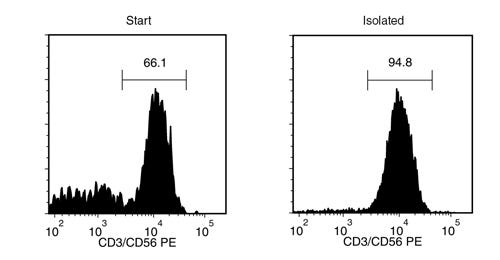
Starting with PBMCs, the CD2+ cell content of the isolated fraction is typically 93.8 ± 3.3% (mean ± SD using the purple EasySep™ Magnet; as assessed by labeling with CD3 and CD56). In the above example, the purities of the start and final isolated fractions are 66.1% and 94.8%, respectively.

Protocols and Documentation

Find supporting information and directions for use in the Product Information Sheet or explore additional protocols below.

Document Type
Product Name
Catalog #
Lot #
Language
Catalog #
17883RF
Lot #
All
Language
English
Catalog #
17883
Lot #
All
Language
English
Document Type
Safety Data Sheet 1
Catalog #
17883RF
Lot #
All
Language
English
Document Type
Safety Data Sheet 2
Catalog #
17883RF
Lot #
All
Language
English
Document Type
Safety Data Sheet 3
Catalog #
17883RF
Lot #
All
Language
English
Document Type
Safety Data Sheet 1
Catalog #
17883
Lot #
All
Language
English
Document Type
Safety Data Sheet 2
Catalog #
17883
Lot #
All
Language
English

Applications

This product is designed for use in the following research area(s) as part of the highlighted workflow stage(s). Explore these workflows to learn more about the other products we offer to support each research area.

Resources and Publications

Publications (12)

A systematic transcriptomic atlas and predictive framework for metabolite-driven T cell state transitions. Y. Xu et al. iScience 2026 Oct

Abstract

Gut microbial and endogenous metabolites are key regulators at the interface of host metabolism and immunity, yet their global effects on human T cell states remain poorly defined. Here, we profile primary human T cell responses to 364 endogenous and microbiota-derived metabolites using high-throughput digital RNA with perturbation of genes sequencing (DRUG-seq), revealing structured transcriptional trajectories spanning baseline, metabolically primed, and highly activated states. We develop DRUG-seq-PerturbFormer, a multi-task deep learning framework that quantitatively captures perturbation magnitude and directionality across these states. This analysis identifies a subset of metabolites that robustly reprogram T cell transcriptional programs. In a dextran sulfate sodium (DSS)-induced colitis model, representative candidates attenuated disease severity and were associated with suppression of inflammatory programs and partial restoration of immune homeostasis. Collectively, these findings show that metabolites act as signals shaping T cell function via transcription, nominating immunomodulatory targets for inflammatory diseases.
Haematopoietic Cells Deficient for Calreticulin or Expressing Its Oncogenic Variants Maintain Functional Antigen Presentation. M. Höhrhan et al. Journal of cellular and molecular medicine 2026 Oct

Abstract

Intact antigen presentation in cancer cells is a key prerequisite for endogenous anticancer T cell responses and a starting point for immunotherapy. Calreticulin was postulated as a chaperone and integral part of the peptide-loading complex of MHC-I. Oncogenic mutations of calreticulin allow surface expression in complex with the thrombopoietin receptor, leading to ligand-independent activation, cell proliferation, and myeloproliferative neoplasms. We hypothesized that mutated calreticulin could also corrupt the function of MHC-I, as previous reports revealed decreased surface expression, peptide-loading defects and retention of MHC-I in the Golgi apparatus. We employed reporter cell models that utilized the T cell response towards target murine and human primary cells and cell lines carrying calreticulin mutations as a functional readout. We also harnessed T cell responses upon a viral infection In Vivo. We found no evidence for immunosuppression in mutant calreticulin-expressing or calreticulin-deficient cells. Our study implies an overestimation of the significance of calreticulin for MHC-I functionality and provides an impulse for reevaluation. Furthermore, we show that calreticulin deficiency affects only a few proteins, including myeloperoxidase and other proteins involved in antibacterial immune mechanisms. In conclusion, mutant calreticulins do not interfere with antigen presentation in MPN, making MHC-I-dependent immunotherapies a viable venue for treatment.
Identification and characterization of a ubiquitin E3 RING ligase of the Chlamydia-like bacterium Simkania negevensis E-M. Hörner et al. PLOS Pathogens 2025 Nov

Abstract

In the arms race between a pathogen and the host, the defense mechanisms of the host cell, including the ubiquitin system, are often counteracted by bacteria. Simkania negevensis (Sne), an obligate intracellular Chlamydia-like bacterium connected with respiratory diseases, possesses numerous deubiquitinases, but not much is known about its other ubiquitin-modifying enzymes. Sne infects a wide range of hosts, developing inside a tubular vacuole in close contact with the host endoplasmic reticulum (ER) and mitochondria. Our study describes an uncharacterized Sne ubiquitin E3 RING-ligase (SNE_A12920 or SneRING), which primarily generates K63- and K11-linked ubiquitin chains and preferentially interacts with UbcH5b and UBE2T E2 enzymes. SneRING is expressed upon infection of various human cell lines, as well as amoebae. We show that a portion of the expressed SneRING co-localizes with mitochondria and ER and that the SneRING interactome includes mitochondrial and ER proteins involved in organelle morphology and stress response. Our work offers an initial characterization of a bacterial RING ligase potentially involved in the host cell remodeling to accommodate the unique intracellular lifestyle of Sne. Author summaryUbiquitination is a protein modification system that regulates protein degradation, localization, or interactions. As such, ubiquitination has many important functions in cell signalling, and its dysregulation can lead to cancer and neurodegenerative diseases. Bacteria that live and develop inside human or other eukaryotic cells, such as Chlamydia, often modulate the ubiquitination system to ensure their own survival. Simkania negevensis is a Chlamydia-like bacterium connected to respiratory diseases in humans. We have discovered a novel enzyme expressed by these bacteria that can ubiquitinate other proteins and thus potentially modify host cell processes that would otherwise hinder infection. In this work, we explore the function of this enzyme and determine its possible cellular localization, as well as some of the proteins it interacts with. Our study provides new insights into how bacterial pathogens adapt to and manipulate host cells using one of the major cell function regulatory systems.