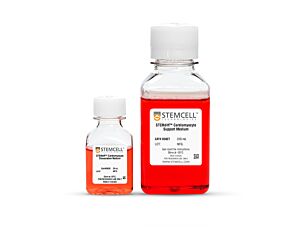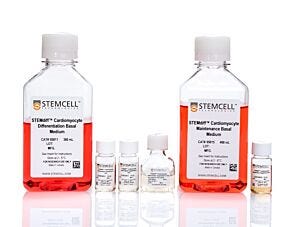
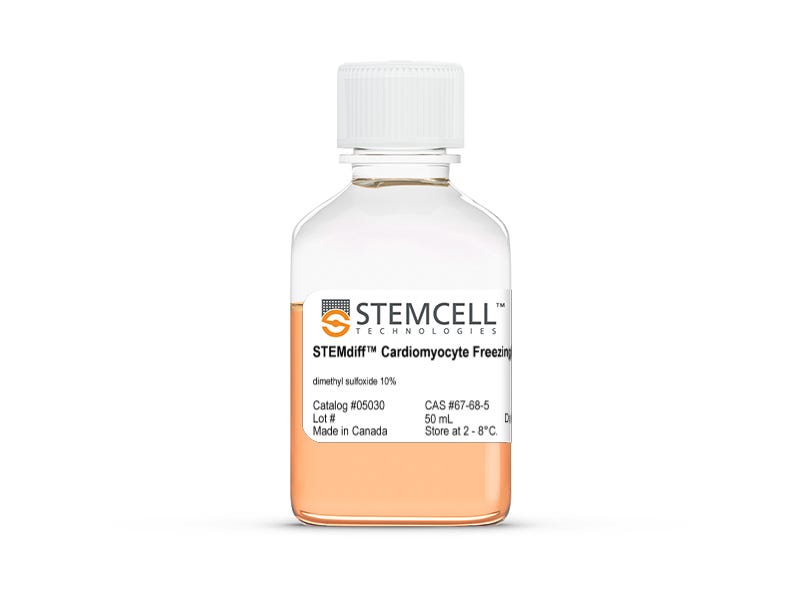
STEMdiff™ Cardiomyocyte Freezing Medium

Medium for cryopreserving hPSC-derived cardiomyocytes

STEMdiff™ Cardiomyocyte Freezing Medium

Medium for cryopreserving hPSC-derived cardiomyocytes
From: 231 USD
Catalog #
(Select a product)
Medium for cryopreserving hPSC-derived cardiomyocytes
Add to Wish List

Product Advantages


  • Achieve greater than 70% cardiomyocyte viability while maintaining functional capacities

  • Supports hPSC-derived cardiomyocytes generated using the STEMdiff™ Cardiomyocyte Differentiation Kit

Products for Your Protocol
To see all required products for your protocol, please consult the Protocols and Documentation.

Overview

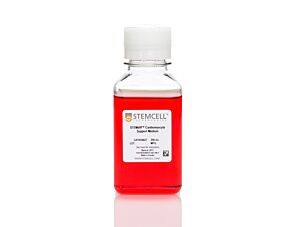
STEMdiff™ Cardiomyocyte Freezing Medium can be used to cryopreserve cardiomyocytes derived from human pluripotent stem cells (hPSCs) and maintained in STEMdiff™ Cardiomyocyte Maintenance Medium (Catalog #05020). STEMdiff™ Cardiomyocyte Dissociation Kit (Catalog #05025) is required for dissociating cardiomyocytes prior to freezing. After thawing using STEMdiff™ Cardiomyocyte Support Medium (Catalog #05027), the cardiomyocytes can be used in various downstream applications and analyses. This medium supports hPSC-derived cardiomyocytes generated using STEMdiff™ Ventricular Cardiomyocyte Differentiation Kit (Catalog #05010) or STEMdiff™ Atrial Cardiomyocyte Differentiation Kit (Catalog #100-0215).

Advantages:
• Achieve greater than 70% cardiomyocyte viability while maintaining functional capacities
• Supports hPSC-derived cardiomyocytes generated using STEMdiff™ Ventricular Cardiomyocyte Differentiation Kit or STEMdiff™ Atrial Cardiomyocyte Differentiation Kit
Cell Type
Cardiomyocytes, PSC-Derived
Species
Human
Application
Cryopreservation
Brand
STEMdiff
Area of Interest
Stem Cell Biology
Formulation Category
Animal Component-Free

Protocols and Documentation

Find supporting information and directions for use in the Product Information Sheet or explore additional protocols below.

Document Type
Product Name
Catalog #
Lot #
Language
Catalog #
05030
Lot #
All
Language
English
Document Type
Safety Data Sheet
Catalog #
05030
Lot #
All
Language
English

Applications

This product is designed for use in the following research area(s) as part of the highlighted workflow stage(s). Explore these workflows to learn more about the other products we offer to support each research area.

Resources and Publications

Publications (2)

Structural and functional benchmarking of monolayer- and bioreactor-generated hiPSC-derived cardiomyocytes. Y. Jang et al. APL bioengineering 2026 Sep

Abstract

Transitioning from animal to human cell sources represents a critical milestone in cardiac tissue engineering and biomedical research. Neonatal rat ventricular myocytes (NRVMs) have long served as the functional benchmark for engineered cardiac tissues; however, their rodent origin limits clinical relevance. Human-induced pluripotent stem cell-derived cardiomyocytes (hiPSC-CMs) offer a renewable, species-specific alternative but remain restricted by immature structure and function, small-scale yield, and high batch variability by conventional two-dimensional monolayer (2D-Mono) differentiation. Here, we systematically evaluated hiPSC-CMs generated by 2D-Mono and three-dimensional embryoid-body (3D-EB) differentiation using identical 15-day Wnt-modulated protocols without additional maturation steps. The 3D-EB method yielded 181 × 106 cells per 100 ml, approximately 2.7-fold higher than the 2D-Mono, while maintaining >80% cTnT+ purity and reduced batch variability. Structural analyses revealed improved sarcomeric organization in 3D-EB tissues compared with 2D-Mono, although both remained less organized than NRVMs, while other morphological parameters were comparable between groups. Functionally, 3D-EB tissues exhibited faster calcium conduction (33.7 cm/s), indicating enhanced electrical coupling relative to 2D-Mono. Although contractile performance remained similar between differentiation formats and below NRVM levels, 3D-EB tissues exhibited consistent structural and functional improvement in calcium wave velocity and contractility over time. These results show that, even without external maturation cues, 3D-EB differentiation yields reproducible, scalable, and human-relevant cardiomyocytes.
Efficient and reproducible generation of human iPSC-derived cardiomyocytes and cardiac organoids in stirred suspension systems M. Prondzynski et al. Nature Communications 2024 Jul

Abstract

Human iPSC-derived cardiomyocytes (hiPSC-CMs) have proven invaluable for cardiac disease modeling and regeneration. Challenges with quality, inter-batch consistency, cryopreservation and scale remain, reducing experimental reproducibility and clinical translation. Here, we report a robust stirred suspension cardiac differentiation protocol, and we perform extensive morphological and functional characterization of the resulting bioreactor-differentiated iPSC-CMs (bCMs). Across multiple different iPSC lines, the protocol produces 1.2E6/mL bCMs with ~94% purity. bCMs have high viability after cryo-recovery (>90%) and predominantly ventricular identity. Compared to standard monolayer-differentiated CMs, bCMs are more reproducible across batches and have more mature functional properties. The protocol also works with magnetically stirred spinner flasks, which are more economical and scalable than bioreactors. Minor protocol modifications generate cardiac organoids fully in suspension culture. These reproducible, scalable, and resource-efficient approaches to generate iPSC-CMs and organoids will expand their applications, and our benchmark data will enable comparison to cells produced by other cardiac differentiation protocols. Subject terms: Cardiovascular biology, Induced pluripotent stem cells, Cardiovascular models