Human IgG ELISA Antibody Pair Kit

For detection and measurement of human immunoglobulin G

New! For your convenience, all of our antibody pair kits now include a vial of Standard Reconstitution Buffer B. This change does not affect product performance or quality.

Human IgG ELISA Antibody Pair Kit

For detection and measurement of human immunoglobulin G
From: 558 USD
Catalog #
(Select a product)
For detection and measurement of human immunoglobulin G
Add to Wish List

What's Included

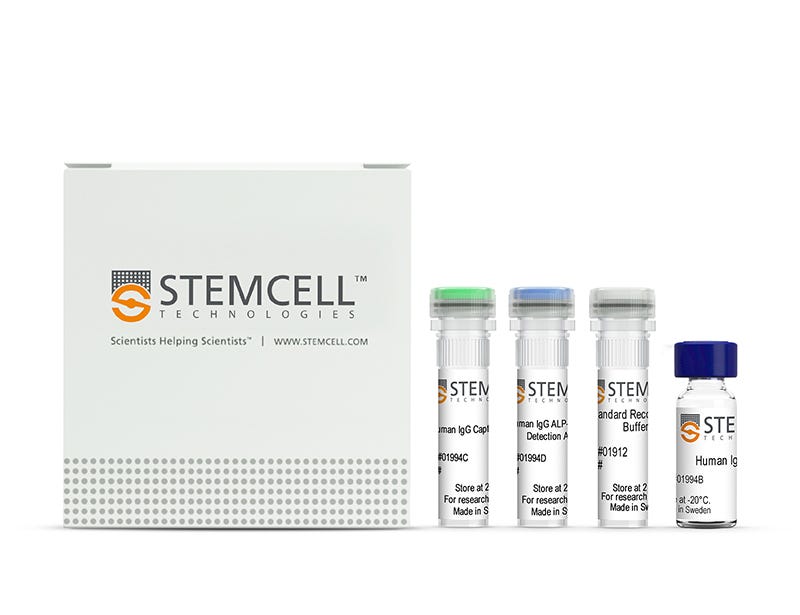
  • Human IgG Capture Antibody, 300 µL
  • Human IgG ALP-Conjugated Detection Antibody, 80 µL
  • Human IgG Standard, 1 vial
  • Standard Reconstitution Buffer B, 1 mL
Products for Your Protocol
To see all required products for your protocol, please consult the Protocols and Documentation.

Overview

The Human Immunoglobulin G (IgG) ELISA Antibody Pair Kit is intended for those who want the flexibility of setting up their own ELISA assay. This kit includes capture and detection antibodies and an IgG standard. It is designed for the quantitative detection and measurement of total human IgG in biological fluids such as serum, plasma, and cell culture supernatants. IgG is the major immunoglobulin found in blood, lymph fluid, cerebrospinal fluid, and peritoneal fluid. IgG plays a key role in the humoral immune response, plays a critical step in the opsonization process by interacting with the Fcγ receptor on macrophages, neutrophils, and natural killer cells, and is able to activate the complement system. IgG is the most abundant immunoglobulin in serum, comprising approximately 80% of all serum immunoglobulins.

The assay is based on the sandwich ELISA method, in which samples are added to ELISA plates coated with capture antibodies specific for the immunoglobulin. The captured immunoglobulin is detected by addition of a detection antibody conjugated to alkaline phosphatase (ALP). Addition of the chromogenic enzyme substrate p-nitrophenyl phosphate (pNPP) results in a colored product with an intensity directly proportional to the concentration of immunoglobulin in the sample. The concentration of the immunoglobulin is determined by comparison to a serial dilution of the immunoglobulin standard analyzed in parallel.

NOTE: This kit includes sufficient reagents for 6 x 96-well ELISA plates (Catalog #38019). ELISA plates and pNPP Substrate (Catalog #01917) are required for use with the Human IgG ELISA Antibody Pair Kit and are available for purchase separately.
Subtype
Antibody Pair Kits
Cell Type
B Cells, Hybridomas
Species
Human
Area of Interest
Hybridoma Generation, Immunology

Data Figures

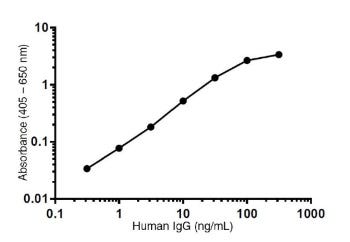
Representative Standard Curve

• Reportable Range: 0.32 - 316 ng/mL. This is the concentration range in which measurement of the analyte can be done with the highest precision, accuracy, and linearity.
• Accuracy: The analyte standard of this ELISA was calibrated against NIBSC international standard 67/086.

Protocols and Documentation

Find supporting information and directions for use in the Product Information Sheet or explore additional protocols below.

Document Type
Product Name
Catalog #
Lot #
Language
Catalog #
01994
Lot #
All
Language
English
Document Type
Safety Data Sheet 1
Catalog #
01994
Lot #
All
Language
English
Document Type
Safety Data Sheet 2
Catalog #
01994
Lot #
All
Language
English
Document Type
Safety Data Sheet 3
Catalog #
01994
Lot #
All
Language
English
Document Type
Safety Data Sheet 4
Catalog #
01994
Lot #
All
Language
English

Applications

This product is designed for use in the following research area(s) as part of the highlighted workflow stage(s). Explore these workflows to learn more about the other products we offer to support each research area.

Resources and Publications

Educational Materials (2)

Publications (1)

Experimental and computational analysis of glycan processing at increased monoclonal antibody productivities. R. Pranomphon et al. Metabolic engineering communications 2026 Dec

Abstract

Optimization of cell culture conditions is critically important for successful commercial production of therapeutic antibodies; however, improvements in productivity may be offset by changes in critical quality attributes. We assessed the impact of two different process conditions (high and low yield) on growth, productivity, and glycan distribution for two CHO-S clones producing adalimumab, clone 1 (DHFR clone) and clone 2 (GS clone) in fed-batch shake flask cultures. High-yield cultures showed approximately 1.6-fold and 7.4-fold increases in integral of viable cells (IVC) for clones 1 and 2, respectively, compared to the low-yield cultures. Although specific productivity was lower in the high-yield cultures, this decrease was offset by the increased IVC, yielding higher titers in both cell lines. High-yield cultures showed a marked decrease in galactosylation, marked by a decrease in G1F glycans compared with the low-yield cultures, across both clones. Man5 glycans remained unchanged in clone 1 cultures, while a slight increase was observed in the high-yield clone 2 cultures. Metabolic analysis showed significant changes in glucose utilization in high-yield cultures with substantial decreases in specific glucose uptake and lactate yield, particularly for clone 2. Calculation of nucleotide sugar fluxes revealed that the increased utilization of UDP-N-acetylglucosamine and UDP-galactose for cellular glycosylation limited their availability for monoclonal antibody (mAb) glycosylation in high IVC, high-yield cultures, consistent with the observed changes in mAb glycans.
New! For your convenience, all of our antibody pair kits now include a vial of Standard Reconstitution Buffer B. This change does not affect product performance or quality.