CellAdhere™ Type I Collagen, Bovine, Solution

Purified bovine collagen for tissue engineering research, cell culture, and biochemistry
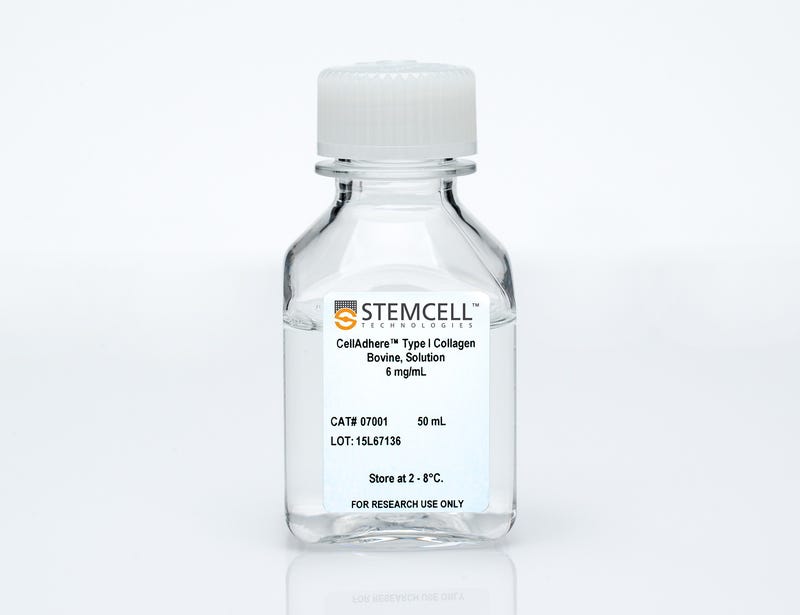
CellAdhere™ Type I Collagen, Bovine, Solution

Purified bovine collagen for tissue engineering research, cell culture, and biochemistry

From: 722 USD
Catalog #
(Select a product)
Purified bovine collagen for tissue engineering research, cell culture, and biochemistry
Add to Wish List

Overview

Support cell attachment by preparing collagen-coated tissue cultureware or 3D collagen gels using CellAdhere™ Type I Collagen, Bovine, Solution. The most abundant type of collagen in the human body, type I collagen is a natural extracellular matrix protein that provides structural support and mimics physiological conditions, making it an ideal cultureware coating surface to support cell attachment.

CellAdhere™ Type I Collagen, Bovine, Solution is prepared from collagen extracted from bovine hide and has a high monomer content. The starting material is isolated from a closed herd and purified using a highly controlled manufacturing process to ensure inactivation of possible prion and/or viral contaminants. This product is sterility tested, with Endotoxin levels verified to be 0.1 EU/mL or less, and is supplied at a concentration of approximately 6 mg/mL (0.6%) aqueous solution in 0.01 M HCl (pH at about 2.0).
Contains
• Approximately 97% type I collagen
• Type III collagen
Species
Human, Mouse, Non-Human Primate, Other, Rat
Brand
CellAdhere

Protocols and Documentation

Find supporting information and directions for use in the Product Information Sheet or explore additional protocols below.

Document Type
Product Name
Catalog #
Lot #
Language
Catalog #
07001
Lot #
All
Language
English
Document Type
Safety Data Sheet
Catalog #
07001
Lot #
All
Language
English

Applications

This product is designed for use in the following research area(s) as part of the highlighted workflow stage(s). Explore these workflows to learn more about the other products we offer to support each research area.

Resources and Publications

Publications (1)

Deep learning-based aberration compensation improves contrast and resolution in fluorescence microscopy M. Guo et al. Nature Communications 2025 Jan

Abstract

Optical aberrations hinder fluorescence microscopy of thick samples, reducing image signal, contrast, and resolution. Here we introduce a deep learning-based strategy for aberration compensation, improving image quality without slowing image acquisition, applying additional dose, or introducing more optics. Our method (i) introduces synthetic aberrations to images acquired on the shallow side of image stacks, making them resemble those acquired deeper into the volume and (ii) trains neural networks to reverse the effect of these aberrations. We use simulations and experiments to show that applying the trained ‘de-aberration’ networks outperforms alternative methods, providing restoration on par with adaptive optics techniques; and subsequently apply the networks to diverse datasets captured with confocal, light-sheet, multi-photon, and super-resolution microscopy. In all cases, the improved quality of the restored data facilitates qualitative image inspection and improves downstream image quantitation, including orientational analysis of blood vessels in mouse tissue and improved membrane and nuclear segmentation in C. elegans embryos. Subject terms: Microscopy, Fluorescence imaging