StemSpan™ CC100

Serum-free culture supplement for expansion of human hematopoietic cells

StemSpan™ CC100

Serum-free culture supplement for expansion of human hematopoietic cells
From: 835 USD
Catalog #
(Select a product)
Serum-free culture supplement for expansion of human hematopoietic cells
Add to Wish List

Overview

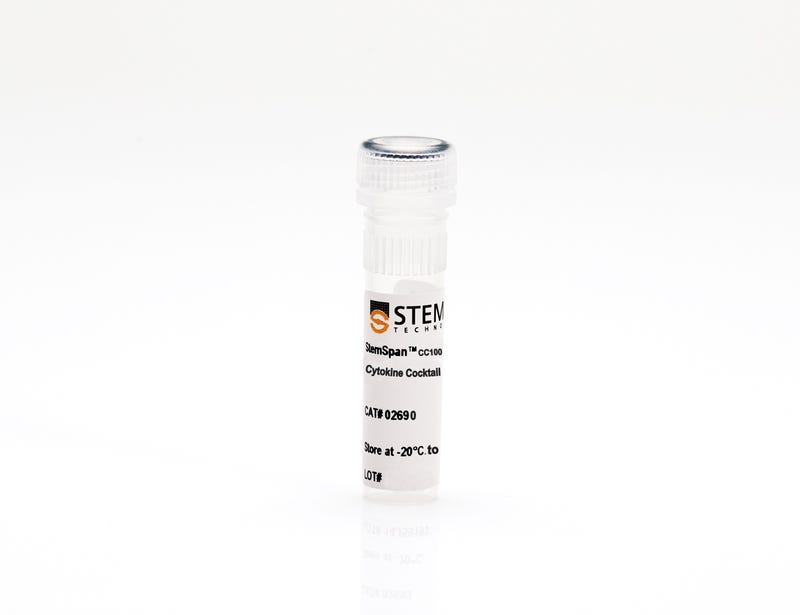
StemSpan™ CC100 cytokine cocktail contains a combination of both early- and late-acting recombinant human (rh) cytokines formulated to support the proliferation of human hematopoietic cells. It is supplied as a 100X concentrate.

When added to serum-free medium, StemSpan™ CC100 promotes the expansion of CD34+ cells isolated from human cord blood and bone marrow, and is recommended if high cell yields and large numbers of CD34+ cells are desired.

We recommend using StemSpan™ CC100 in combination with any of the following StemSpan™ media:
• StemSpan™ SFEM (Catalog #09600)
• StemSpan™ SFEM II (Catalog #09605)
• StemSpan™-XF (Catalog #100-0073)
• StemSpan™-AOF (Catalog #100-0130)
Contains
• Recombinant human fms-like tyrosine kinase 3 ligand (Flt3L)
• Recombinant human stem cell factor (SCF)
• Recombinant human interleukin 3 (IL-3)
• Recombinant human interleukin 6 (IL-6)
Subtype
Supplements
Cell Type
Hematopoietic Stem and Progenitor Cells
Species
Human
Application
Cell Culture, Expansion
Brand
StemSpan
Area of Interest
Drug Discovery and Toxicity Testing, Stem Cell Biology, Transplantation Research
Formulation Category
Serum-Free

Data Figures

Expansion of CD34 + Human Cord Blood Cells in StemSpan™ Media Containing CC100 Cytokine Cocktail

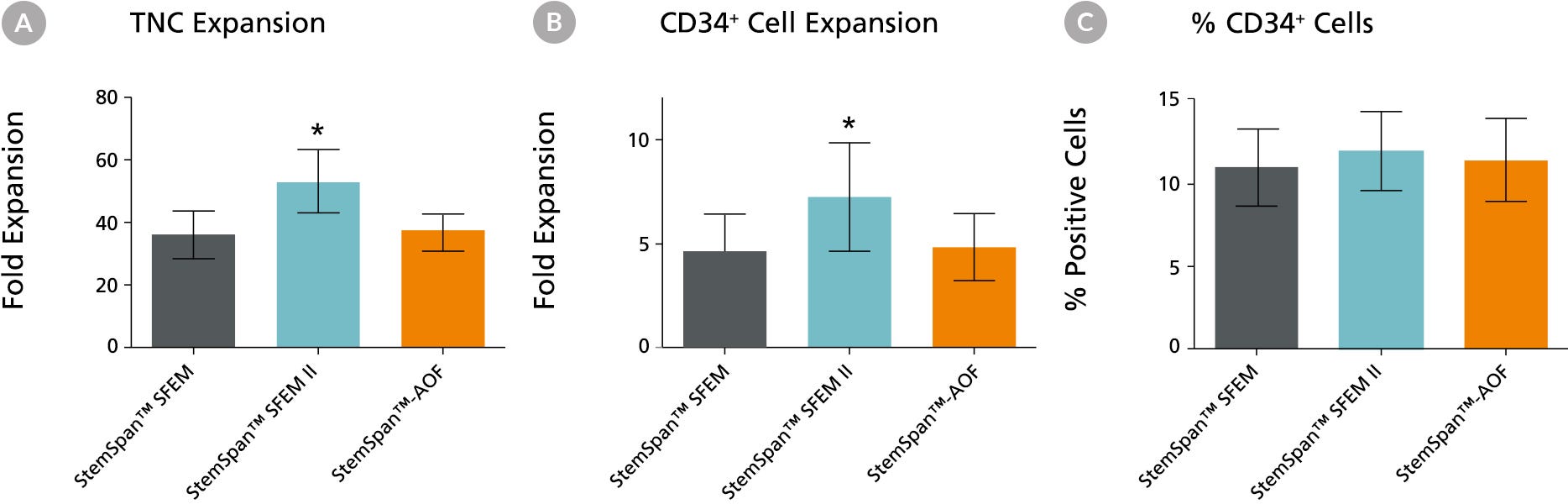
Figure 1. Expansion of CD34+ Human Cord Blood Cells in StemSpan™ Media Containing CC100 Cytokine Cocktail

Purified CD34+ human cord blood (CB) cells were suspended at a concentration of 10,000 per mL in StemSpan™ SFEM (dark gray bars), SFEM II (blue bars) and AOF (orange bars) media containing CC100 Cytokine Cocktail (Catalog #02690). Cultures were maintained for 7 days, after which the cells were counted and examined for CD34 and CD45 expression by flow cytometry. Shown are the fold expansion of total nucleated cells (TNC) (A) and CD34+ cells (B) per input CD34+ cell, and the percent CD34+ cells (C). Results represent the average of 32 different CB samples. Vertical lines indicate 95% confidence limits, the range within which 95% of results fall. The numbers of cells produced in StemSpan™ SFEM II were significantly higher than in StemSpan™ SFEM and StemSpan™-AOF (*P<0.001, paired t-test, n=32).

Note: Data for StemSpan™-AOF shown were generated with the original phenol red-containing version StemSpan™-ACF (Catalog #09855). However internal testing showed that the performance of the new phenol red-free, cGMP-manufactured version, StemSpan™-AOF (Catalog #100-0130) was comparable.

StemSpan™ SFEM II Serum-Free Expansion Medium Containing CC100 Cytokine Cocktail Supports Greater Expansion of Human CD34 + Cells Than Other Media Tested

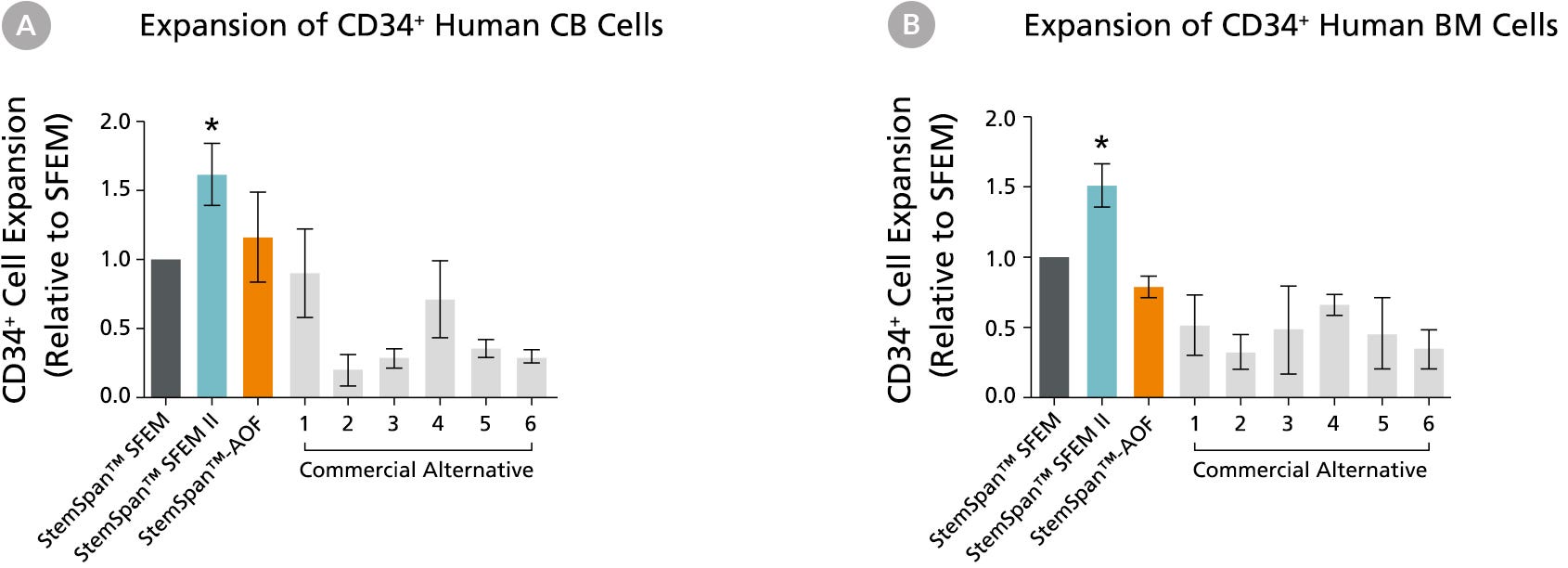
Figure 2. StemSpan™ SFEM II Serum-Free Expansion Medium Containing CC100 Cytokine Cocktail Supports Greater Expansion of Human CD34+ Cells Than Other Media Tested

Expansion of CD34+ cells, normalized relative to the values obtained in StemSpan™ SFEM medium (dark gray bars) after culturing purified CD34+ CB (A, n=6) or bone marrow (BM) (B, n=3) cells for 7 days in StemSpan™ SFEM, SFEM II (blue bars) and AOF (orange bars), and six media from other commercial suppliers (light gray bars, Commercial Alternative 1-6, which included, in random order, StemPro34 (Life Technologies), X-Vivo-15 and HPGM (both from Lonza), SCGM (Cellgenix), StemLine II (Sigma) and HP01 (Macopharma)). All media were supplemented with StemSpan™ CC100 Cytokine Cocktail (Catalog #02690). Vertical lines indicate 95% confidence limits, the range within which 95% of results fall. The numbers of CB and BM cells produced in StemSpan™ SFEM II were significantly higher than in all other media, except the numbers of CB cells produced in StemSpan™-AOF (*p<0.05, paired t-test).

Note: Data for StemSpan™-AOF shown were generated with the original phenol red-containing version StemSpan™-ACF (Catalog #09855). However internal testing showed that the performance of the new phenol red-free, cGMP-manufactured version, StemSpan™-AOF (Catalog #100-0130) was comparable.

Protocols and Documentation

Find supporting information and directions for use in the Product Information Sheet or explore additional protocols below.

Document Type
Product Name
Catalog #
Lot #
Language
Product Name
StemSpan™ CC100
Catalog #
02690
Lot #
All
Language
English
Document Type
Safety Data Sheet
Product Name
StemSpan™ CC100
Catalog #
02690
Lot #
All
Language
English

Applications

This product is designed for use in the following research area(s) as part of the highlighted workflow stage(s). Explore these workflows to learn more about the other products we offer to support each research area.

Resources and Publications

Publications (39)

Rapid Transcription Dynamics Confers Cytarabine Resistance in Acute Myeloid Leukemia. G. Tatsumi et al. Blood cancer discovery 2026 Jul

Abstract

UNLABELLED: Chemotherapy resistance remains a critical challenge in the treatment of patients with cancer, including acute myeloid leukemia (AML). Although genetic alterations can contribute to resistance, the role of rapid-adaptive nongenetic mechanisms, particularly transcription dynamics, remains poorly understood. In this article, we demonstrate that short-term treatment of AML cells with the widely used chemotherapeutic cytarabine (AraC) leads to the rapid emergence of a cell population with significant RNA induction and increased AraC resistance in cell lines and primary patient samples. Mechanistically, transcriptomic and targeted high-resolution analysis of transcription dynamics using single-molecule RNA FISH revealed rapid induction of transcriptional dynamics and upregulation of key transcription factors (TF)-which we term "AraC rapid response TFs." Functionally, short-term pre- and cotreatment with RNA transcription inhibitors suppressed chemotherapy-induced RNA induction and prevented resistance acquisition in vitro and in vivo. Furthermore, CRISPR-mediated suppression of TFs PU.1 and GATA1 significantly attenuated AraC resistance. Our findings reveal a role of rapid-adaptive transcriptional dynamics in AML chemotherapy resistance. SIGNIFICANCE: This study reveals a role of rapid-adaptive transcriptional dynamics in AML chemotherapy resistance, highlighting master TFs as key regulators. These insights offer a pharmacologically accessible approach to potentially alleviate the major clinical problem of chemotherapy resistance.
Loss of function of Adducin 3 (ADD3) causes abnormal development and impaired barrier function of human and mouse bile duct cells resulting in increased incidence and severity of Biliary Atresia J. L. H. Ha et al. eBioMedicine 2025 Nov

Abstract

Background: Biliary atresia (BA) is the most prevalent serious neonatal biliary obstructive disorder and is a complex multifactorial liver disorder. Genome-wide association studies have identified Adducin 3 (ADD3) as a BA susceptibility gene but the mechanisms involved in disease causation and progression remain unclear. Methods: ADD3 knockout human pluripotent stem cells were differentiated into cholangiocyte organoids to assess the effect of ADD3 deletion on biliary development in vitro. Add3 deletion in rhesus rotavirus (RRV)-induced experimental BA mice were employed as the in vivo model to address the impact of reduced Add3 expression on BA pathogenesis. Findings: ADD3 knockout organoids displayed defective cholangiocyte differentiation, failure in the recruitment of βII-spectrin to the cell membrane, abnormal primary cilia development, reduced expression of tight junction proteins, lower transepithelial electrical resistance (TEER) and increased paracellular permeability. Statistical significantly reduced tight junction (TJ) proteins expression and lower TEER in Add3+/− and Add3−/− liver tissue-derived cholangiocytes were observed. Reduced number of TJs and enlarged paracellular spaces without any detectable TJ were detected in the intra-hepatic bile ducts of Add3+/− and Add3−/− livers. A statistical significantly higher incidence and a more advanced form of BA with statistical significantly higher serum bilirubin, liver necrosis and fibrosis, and accumulation of macrophages and activated hepatic stellate cells were observed in Add3 knockout BA mice as compared to wild-type BA mice. Interpretation: Dysregulated ADD3 expression caused an abnormal development and impaired barrier function of cholangiocytes, and the resultant increase in bile duct permeability rendered the foetus/neonate susceptible to a more severe injury response to an external insult. The findings support the hypothetical pathogenic model of genetic susceptibility genes being involved in hepatobiliary development/structure, and the perturbed embryogenesis of the biliary tree and its disrupt integrity increase the host susceptibility to biliary injury and BA.
Replication stress responses in human lymphocytes change sex-specifically during aging M. Rall-Scharpf et al. Nucleic Acids Research 2025 Jun

Abstract

AbstractThe varying incidence of aging-related diseases and the gender gap in life expectancy suggest differences in the aging process between the sexes. Yet, little is known about sex-specific differences in genomic instability, a key factor in aging. Here, we analyzed DNA damage responses (DDRs) in cycling peripheral blood lymphocytes (PBL) and hematopoietic stem and progenitor cells (HSPC) from female and male donors of different age, focusing on replication stress. Transcriptomics revealed striking sex-dependent expression changes in DDR pathways during aging. Particularly, various DDR components, involved in DNA repair and replication fork remodeling, were upregulated with age in men. In older women, functional analysis indicated reduced activity of the Fanconi anemia pathway. Analyses of replication dynamics, PCNA ubiquitination, translesion synthesis (TLS)-polymerase signals, and sensitivities to TLS-polymerase inhibitors indicate a shift from fork remodeling to fast TLS inducing nonclassical replication stress. While replication dynamics were unaltered and replication stress rather reduced, PBL from older men were highly dependent on PARP activity. In conclusion, our findings revealed sex-specific strategies to cope with replication stress in PBL from older individuals, namely through DNA damage tolerance pathway switching in women and PARP activation in men, differentially contributing to the decline of genomic stability with age. Graphical Abstract Graphical Abstract