RosetteSep™ Human T Cell Enrichment Cocktail

Immunodensity negative selection cocktail

RosetteSep™ Human T Cell Enrichment Cocktail

Immunodensity negative selection cocktail

From: 256 USD
Catalog #
(Select a product)
Immunodensity negative selection cocktail
Add to Wish List

Product Advantages


  • Fast and easy-to-use

  • Requires no special equipment or training

  • Isolated cells are untouched

  • Can be combined with SepMate™ for consistent, high-throughput sample processing

What's Included

  • RosetteSep™ Human T Cell Enrichment Cocktail (Catalog #15021)
    • RosetteSep™ Human T Cell Enrichment Cocktail, 2 mL
  • RosetteSep™ Human T Cell Enrichment Cocktail (Catalog #15061)
    • RosetteSep™ Human T Cell Enrichment Cocktail, 5 x 2 mL
Products for Your Protocol

Overview

The RosetteSep™ Human T Cell Enrichment Cocktail is designed to isolate T cells from whole blood by negative selection. Unwanted cells are targeted for removal with Tetrameric Antibody Complexes recognizing non-T cells and glycophorin A on red blood cells (RBCs). When centrifuged over a buoyant density medium such as RosetteSep™ DM-L (Catalog #15705) or Lymphoprep™ (Catalog #18060), the unwanted cells pellet along with the RBCs. The purified T cells are present as a highly enriched population at the interface between the plasma and the buoyant density medium.
Subtype
Cell Isolation Kits
Cell Type
T Cells
Species
Human
Sample Source
Buffy Coat, Whole Blood
Selection Method
Negative
Application
Cell Isolation
Brand
RosetteSep
Area of Interest
Immunology

Data Figures

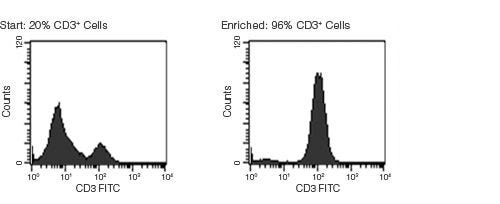
Typical RosetteSep™ HLA T Cell Enrichment Profile

Figure 1. Typical RosetteSep™ T Cell Enrichment Profile

Starting with fresh whole blood the CD3+ cell content of the enriched fraction typically ranges from 90% - 97%. Red blood cells were removed by lysis prior to flow cytometry.

Protocols and Documentation

Find supporting information and directions for use in the Product Information Sheet or explore additional protocols below.

Document Type
Product Name
Catalog #
Lot #
Language
Catalog #
15021, 15061
Lot #
All
Language
English
Document Type
Safety Data Sheet
Catalog #
15021, 15061
Lot #
All
Language
English

Applications

This product is designed for use in the following research area(s) as part of the highlighted workflow stage(s). Explore these workflows to learn more about the other products we offer to support each research area.

Resources and Publications

Frequently Asked Questions

What is RosetteSep™?

RosetteSep™ is a rapid cell separation procedure for the isolation of purified cells directly from whole blood, without columns or magnets.

How does RosetteSep™ work?

The antibody cocktail crosslinks unwanted cells to red blood cells (RBCs), forming rosettes. The unwanted cells then pellet with the free RBCs when centrifuged over a density centrifugation medium (e.g. Ficoll-Paque™ PLUS, Lymphoprep™).

What factors affect cell recovery?

The temperature of the reagents can affect cell recovery. All reagents should be at room temperature (sample, density centrifugation medium, PBS, centrifuge) before performing the isolations. Layering can also affect recovery so be sure to carefully layer the sample to avoid mixing with the density centrifugation medium as much as possible. Be sure to collect the entire enriched culture without disturbing the RBC pellet. A small amount of density centrifugation medium can be collected without worry.

Which cell samples can RosetteSep™ be used with?

RosetteSep™ can be used with leukapheresis samples, bone marrow or buffy coat, as long as: the concentration of cells does not exceed 5 x 10⁷ per mL (can dilute if necessary); and there are at least 100 RBCs for every nucleated cell (RBCs can be added if necessary).

Can RosetteSep™ be used with previously frozen or cultured cells?

Yes. Cells should be re-suspended at 2 - 5 x 10⁷ cells / mL in PBS + 2% FBS. Fresh whole blood should be added at 250 µL per mL of sample, as a source of red cells.

Can RosetteSep™ be used to enrich progenitors from cord blood?

Yes. Sometimes cord blood contains immature nucleated red cells that have a lower density than mature RBCs. These immature red cells do not pellet over Ficoll™, which can lead to a higher RBC contamination than peripheral blood separations.

Does RosetteSep™ work with mouse cells?

No, but we have developed EasySep™, a magnetic-based cell isolation system which works with mouse and other non-human species.

Which anticoagulant should be used with RosetteSep™?

Peripheral blood should be collected in heparinized Vacutainers. Cord blood should be collected in ACD.

Should the anticoagulant be washed off before using RosetteSep™?

No, the antibody cocktail can be added directly to the sample.

Publications (70)

Identification of elements determining KIR gene demethylation at the CD56-bright stage of NK cell development. H. Li et al. iScience 2026 Sep

Abstract

The variegated expression of the KIR family of class I MHC receptors generates specialized natural killer (NK) cells capable of allele-specific HLA recognition. Understanding the mechanism of KIR gene activation will lead to improved methods for the generation of fully functional NK cells. A central RUNX-binding site in the KIR proximal promoter is required for gene activation. RUNX proteins recruit ten-eleven translocation (TET) proteins that generate 5-hydroxymethylcytosine (5hmC) and drive DNA demethylation. Assessment of 5-methylcytosine (5mC) and 5hmC residues at four stages of NK cell development reveals deposition of 5hmC primarily in a CREB site next to the RUNX site at the CD56Bright stage but not the subsequent CD56Dim stage representing fully mature NK cells. KIR promoter demethylation is delayed relative to other lineage-associated genes, indicating a high threshold for KIR gene demethylation in developing NK cells, and a window of opportunity for RUNX/TET-dependent KIR gene activation in CD56Bright NK cells.
Tunable universal OR-gated CAR T cells for AML. M. Siddiqui et al. iScience 2026 Aug

Abstract

Acute myeloid leukemia (AML) is characterized by antigen heterogeneity and poor prognosis. Here, to tackle the heterogeneity of AML, we combined FLT3 with CD33 in a combinatorial OR-gate approach using our split, universal, programmable (SUPRA) chimeric antigen receptor (CAR) platform. The split platform affords tunability over activation levels and multiplexed targeting. We characterized the specificity and sensitivity of different SUPRA CAR adapters for each target across a panel of target cell lines. Our results demonstrate that this CAR system can effectively target two antigens with equivalent efficacy to conventional CARs while reducing the engineering burden of designing CAR T cells against multiple antigens. Furthermore, we can characterize an effective dose range where off-target cytotoxicity against hematopoietic stem and progenitor cells is minimized. Our SUPRA OR gate has the potential to provide an effective and safer solution to treating AML.
A deep single cell mass cytometry approach to capture canonical and noncanonical cell cycle states M. Amouzgar et al. Nature Communications 2025 Oct

Abstract

The cell cycle (CC) underpins diverse cell processes like cell differentiation, cell expansion, and tumorigenesis but current single-cell (sc) strategies study CC as: coarse phases, rely on transcriptomic signatures, use imaging modalities limited to adherent cells, or lack high-throughput multiplexing. To solve this, we develop an expanded, Mass Cytometry (MC) approach with 48 CC-related molecules that deeply phenotypes the diversity of scCC states. Using Cytometry by Time of Flight, we quantify scCC states across suspension and adherent cell lines, and stimulated primary human T cells. Our approach captures the diversity of scCC states, including atypical CC states beyond canonical definitions. Pharmacologically-induced CC arrest reveals that perturbations exacerbate noncanonical states and induce previously unobserved states. Notably, primary cells escaping CC inhibition demonstrated aberrant CC states compared to untreated cells. Our approach enables deeper phenotyping of CC biology that generalizes to diverse cell systems with simultaneous multiplexing and integration with MC platforms. Subject terms: Assay systems, Proteomics, Cell biology, Immunology, Systems biology