Human LDL

Low-density lipoproteins pre-screened for hematopoietic cell growth

Human LDL

Low-density lipoproteins pre-screened for hematopoietic cell growth

From: 612 USD
Catalog #
(Select a product)
Low-density lipoproteins pre-screened for hematopoietic cell growth
Add to Wish List

Overview

This product is a human plasma-derived low-density lipoprotein (LDL)-based culture supplement that has been pre-screened for the culture, expansion, and colony assay of human hematopoietic and non-hematopoietic cells in serum-free culture media. It promotes the proliferation and survival of human hematopoietic and other progenitor cells in culture, resulting in increased cell output in expansion cultures and increased colony numbers and/or size in colony assays.
Contains
• A clear micro-emulsion of low-density lipoproteins in an aqueous solution
•  ≥ 5 mg/mL protein as determined by modified Lowry Method using bovine serum albumin as a standard
Subtype
Supplements
Cell Type
Hematopoietic Stem and Progenitor Cells, Other
Species
Human
Application
Cell Culture

Data Figures

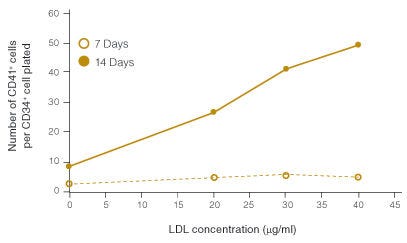
Importance of Low Density Lipoproteins

Figure 1. Importance of Low Density Lipoproteins

Effect of low density lipoproteins (LDLs) on megakaryocyte expansion in StemSpan™ H3000 supplemented with StemSpan™ Megakaryocyte Expansion Supplement

Protocols and Documentation

Find supporting information and directions for use in the Product Information Sheet or explore additional protocols below.

Document Type
Product Name
Catalog #
Lot #
Language
Product Name
Human LDL
Catalog #
02698
Lot #
All
Language
English
Document Type
Safety Data Sheet
Product Name
Human LDL
Catalog #
02698
Lot #
All
Language
English

Applications

This product is designed for use in the following research area(s) as part of the highlighted workflow stage(s). Explore these workflows to learn more about the other products we offer to support each research area.

Resources and Publications

Publications (4)

Targeting BIRC6 rejuvenates hematopoietic stem cell aging and immunosenescence. W. Liao et al. Signal transduction and targeted therapy 2026 Sep

Abstract

Immunosenescence represents a central hallmark of organismal aging, characterized by a progressive decline in immune function, which compromises host defense and accelerates systemic aging. Hematopoietic stem cell (HSC) aging is a key contributor to this process, characterized by aberrant expansion, myeloid-biased differentiation, and impaired self-renewal, culminating in hematopoietic-immune imbalance. Although the expansion and survival advantages of aged HSCs have been well-demonstrated, the underlying mechanisms remain elusive. Here, we reveal that regulatory T cells (Tregs) within the bone marrow (BM) microenvironment actively safeguard the survival of aged HSCs via a previously uncharacterized signaling pathway. We identify a novel aged HSC subpopulation characterized by high expression of Baculoviral IAP Repeat Containing 6 (BIRC6), an apoptosis inhibitor. This BIRC6-high subpopulation is markedly expanded in aged mice and recapitulates the hallmarks of HSC aging. Mechanistically, cAMP derived from BM Tregs activates the PKA-CREB pathway in HSCs, activating Birc6 transcription, which reduces apoptotic priming in aged HSCs, thereby promoting hematopoietic-immune imbalance. Strikingly, targeted BIRC6 inhibition in HSCs using antibody-conjugated lipid nanoparticle-encapsulated antisense oligonucleotides (LNP-ASOs) significantly reverses hematopoietic-immune aging phenotypes and ameliorates age-associated immune dysfunction in middle-aged mice. LNP-ASO treatment dramatically rebalances immune cell production, reduces immunosenescence markers, and enhances vaccine responses in middle-aged mice. More importantly, this strategy was also effective in HSCs from middle-aged human donors, highlighting its potential for clinical translation. These findings elucidate a key microenvironmental pathway (Treg-cAMP-PKA-CREB-BIRC6) driving HSC aging and offer a novel strategy to ameliorate the aged hematopoietic system and combat age-related immune decline.
Asymmetric organelle inheritance predicts human blood stem cell fate. D. Loeffler et al. Blood 2022 mar

Abstract

Understanding human hematopoietic stem cell fate control is important for its improved therapeutic manipulation. Asymmetric cell division, the asymmetric inheritance of factors during division instructing future daughter cell fates, was recently described in mouse blood stem cells. In human blood stem cells, the possible existence of asymmetric cell division remained unclear because of technical challenges in its direct observation. Here, we use long-term quantitative single-cell imaging to show that lysosomes and active mitochondria are asymmetrically inherited in human blood stem cells and that their inheritance is a coordinated, nonrandom process. Furthermore, multiple additional organelles, including autophagosomes, mitophagosomes, autolysosomes, and recycling endosomes, show preferential asymmetric cosegregation with lysosomes. Importantly, asymmetric lysosomal inheritance predicts future asymmetric daughter cell-cycle length, differentiation, and stem cell marker expression, whereas asymmetric inheritance of active mitochondria correlates with daughter metabolic activity. Hence, human hematopoietic stem cell fates are regulated by asymmetric cell division, with both mechanistic evolutionary conservation and differences to the mouse system.
The NAD-Booster Nicotinamide Riboside Potently Stimulates Hematopoiesis through Increased Mitochondrial Clearance. N. Vannini et al. Cell stem cell 2019 mar

Abstract

It has been recently shown that increased oxidative phosphorylation, as reflected by increased mitochondrial activity, together with impairment of the mitochondrial stress response, can severely compromise hematopoietic stem cell (HSC) regeneration. Here we show that the NAD+-boosting agent nicotinamide riboside (NR) reduces mitochondrial activity within HSCs through increased mitochondrial clearance, leading to increased asymmetric HSC divisions. NR dietary supplementation results in a significantly enlarged pool of progenitors, without concurrent HSC exhaustion, improves survival by 80{\%}, and accelerates blood recovery after murine lethal irradiation and limiting-HSC transplantation. In immune-deficient mice, NR increased the production of human leucocytes from hCD34+ progenitors. Our work demonstrates for the first time a positive effect of NAD+-boosting strategies on the most primitive blood stem cells, establishing a link between HSC mitochondrial stress, mitophagy, and stem-cell fate decision, and unveiling the potential of NR to improve recovery of patients suffering from hematological failure including post chemo- and radiotherapy.