IntestiCult™ Organoid Growth Medium (Mouse)

Cell culture medium for establishment and maintenance of mouse intestinal organoids
Interested in trying STEMCELL’s organoid products for your intestinal research? Fill out the form to request information about introductory offers.

IntestiCult™ Organoid Growth Medium (Mouse)

Cell culture medium for establishment and maintenance of mouse intestinal organoids

From: 424 USD
Catalog #
(Select a product)
Cell culture medium for establishment and maintenance of mouse intestinal organoids
Add to Wish List

Product Advantages


  • Convenient, in vitro system that recapitulates the identity and organization of the adult intestinal epithelium, including intra- and intercellular signaling, self-propagating stem cell niche and functional transport into and out of the lumen

  • Serum-free and defined medium formulation that delivers consistent results

  • Enables generation of intestinal organoids in less than one week

  • Simple format and easy-to-use protocol

What's Included

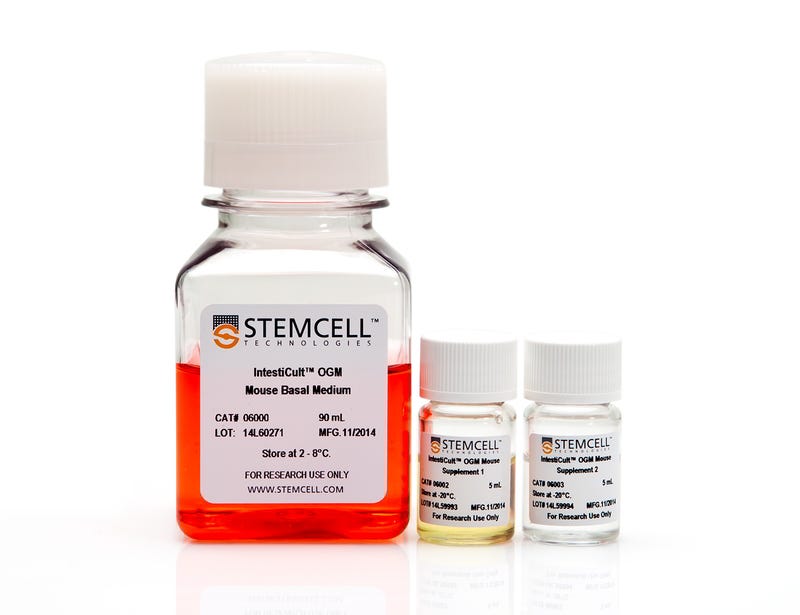
  • IntestiCult™ OGM Mouse Basal Medium, 90 mL
  • IntestiCult™ OGM Mouse Supplement 1, 5 mL
  • IntestiCult™ OGM Mouse Supplement 2, 5 mL
Products for Your Protocol
To see all required products for your protocol, please consult the Protocols and Documentation.

Overview

IntestiCult™ Organoid Growth Medium (Mouse) is a defined, serum-free cell culture medium for efficient establishment and long-term maintenance of mouse intestinal organoids. These organoids, or “mini-guts”, provide a convenient in vitro organotypic culture system for studying both the small and large intestinal epithelium and associated stem cell dynamics. Organoids grown in IntestiCult™ feature a polarized epithelium that contains all of the known cell types of the adult intestinal epithelium. Individual intestinal crypts rapidly form organoids when cultured in IntestiCult™ Organoid Growth Medium (Mouse). Applications of these cultures include studying the development and function of the normal and tumorigenic intestinal epithelium, modeling intestinal disease, and investigating stem cell properties and regenerative therapy approaches. Organoid culture enables convenient in vitro characterization of a system with strong physiological relevance to the adult intestine.

Should you intend to use this product for commercial purposes, please contact HUB at www.huborganoids.nl for a commercial use license or for clarifications in relation to HUB licensing.
Subtype
Specialized Media
Cell Type
Intestinal Cells
Species
Mouse
Application
Cell Culture, Differentiation, Expansion, Maintenance, Organoid Culture
Brand
IntestiCult
Area of Interest
Cancer, Disease Modeling, Drug Discovery and Toxicity Testing, Epithelial Cell Biology, Stem Cell Biology
Formulation Category
Serum-Free

Protocols and Documentation

Find supporting information and directions for use in the Product Information Sheet or explore additional protocols below.

Document Type
Product Name
Catalog #
Lot #
Language
Catalog #
06005
Lot #
All
Language
English
Document Type
Safety Data Sheet 1
Catalog #
06005
Lot #
All
Language
English
Document Type
Safety Data Sheet 2
Catalog #
06005
Lot #
All
Language
English
Document Type
Safety Data Sheet 3
Catalog #
06005
Lot #
All
Language
English

Applications

This product is designed for use in the following research area(s) as part of the highlighted workflow stage(s). Explore these workflows to learn more about the other products we offer to support each research area.

Resources and Publications

Educational Materials (39)

Publications (133)

Age‐Associated Impairment of Paneth Cells Driven by microRNA‐152 Promotes Intestinal Epithelial Vulnerability to Pathological Stress B. Warner et al. Aging Cell 2026 May

Abstract

ABSTRACTAdvanced age is a well‐known risk factor for severe complications in surgical patients with critical illnesses, partly due to declined intestinal mucosal defense, but the underlying mechanism remains largely unknown. Our study provided direct evidence from older human and mouse small intestines of the adverse impact of aging on Paneth cell functionality by impaired mitochondrial metabolism. Mechanistic investigation revealed a specific elevation of Paneth cell enriched microRNA‐152 (miR‐152) in aging small intestinal epithelium. Increased miR‐152 impaired Paneth cells of aging small intestine by inhibiting mitochondrial protein Prohibitin1 (PHB1) expression and disrupting mitochondrial respiration. Moreover, the levels of circHIPK3, an intestinal circular RNA that counters the function of miR‐152, also declined in older intestines, further enabling miR‐152‐mediated deterioration in Paneth cell function. Conversely, antagonizing miR‐152 improved mitochondrial metabolism by restoring PHB1 levels and ameliorated the functional decline of old Paneth cells. Our findings indicate that dysregulated miR‐152 expression and activity play a central role in the loss of Paneth cell homeostasis in the aging small intestine, offering translational insights for protecting intestinal mucosal integrity in older patients. Aging associated miR‐152 dysregulation plays a central role in the loss of Paneth cell homeostasis by inhibiting mitochondrial protein Prohibitin1 (PHB1) expression, which contributes to increased small intestinal vulnerability to pathological stresses.
Urolithin A activates aryl hydrocarbon receptor-NLRP6-mediated pathways in intestinal epithelial cells to modulate mucosal immunity and strengthen gut barrier integrity. S. Ghosh et al. Nature communications 2026 Jun

Abstract

The aryl hydrocarbon receptor (AHR) plays a central role in orchestrating gut barrier and mucosal immune functions in the pathogenesis of inflammatory bowel disease (IBD). Nevertheless, activation of the AHR by diverse ligands yields varied outcomes, and the downstream pathways responsible for these effects remain unknown. Here, we report that selective activation of AHR in mouse intestinal epithelial cells (IEC) by the microbial metabolite, urolithin A (UroA), triggers the Nod-like receptor pyrin domain-containing protein 6 (NLRP6) inflammasome, resulting in the release of interleukin (IL)-18 but not IL-1β. Further, we show that UroA-induced IL-18 in IECs is critical for IL-22, mucin 2 and REG3γ production, as well as protection against colitis. Moreover, UroA significantly upregulates IL-18 and IL-22 levels in IECs and type-3 innate lymphoid cells, respectively, in intestinal biopsies from patients with IBD patients. These results demonstrate that activation of AHR by UroA modulates intestinal barrier function through an NLRP6-IL-18-IL-22 pathway in both healthy and IBD conditions.
Leucine-Restricted Diet Attenuates Small Intestinal Tumorigenesis in ApcMin /+ Mice. Y. Sui et al. Food science & nutrition 2026 Jul

Abstract

Red and processed meats have been implicated in intestinal tumorigenesis; however, the roles of their main nutritional components, amino acids, in the modulation of adenoma development remain unclear. This study aimed to investigate the roles of various amino acids in intestinal tumorigenesis. ApcMin/+ mice, as a model of spontaneous intestinal adenoma, were fed diets restricted to essential amino acids (leucine, lysine, valine), or the non-essential amino acid arginine to observe the modulation of tumorigenesis. The mice were fed diets with a reduction in each amino acid starting at 5 weeks of age and analyzed at 15 weeks of age. Among the diets tested, only the 90% leucine-restricted (Leu-R) diet dramatically reduced the size and number of small intestinal tumors. Mechanistically, both cell proliferation and mTORC1 pathway activation were reduced in tumors from the 90% Leu-R group. Further, Gene Set Enrichment Analysis (GSEA) showed that the 90% Leu-R diet affected pathways related to DNA repair and genome stability in small intestinal tumors. Notably, mismatch repair (MMR) genes, Mlh1, Msh2, and Pms2, were upregulated in small intestinal tumors from the 90% Leu-R group. Organoids derived from small intestinal tumors from the 90% Leu-R group exhibited fewer and smaller spherical structures. Leucine plays a key role in small intestinal tumorigenesis in ApcMin/+ mice. The 90% Leu-R diet suppressed activation of the mTORC1 pathway and maintained genomic stability presumably via the MMR system. These findings suggest the potential for tumor prevention strategies targeting specific essential amino acids.
Interested in trying STEMCELL’s organoid products for your intestinal research? Fill out the form to request information about introductory offers.