Collagenase/Hyaluronidase

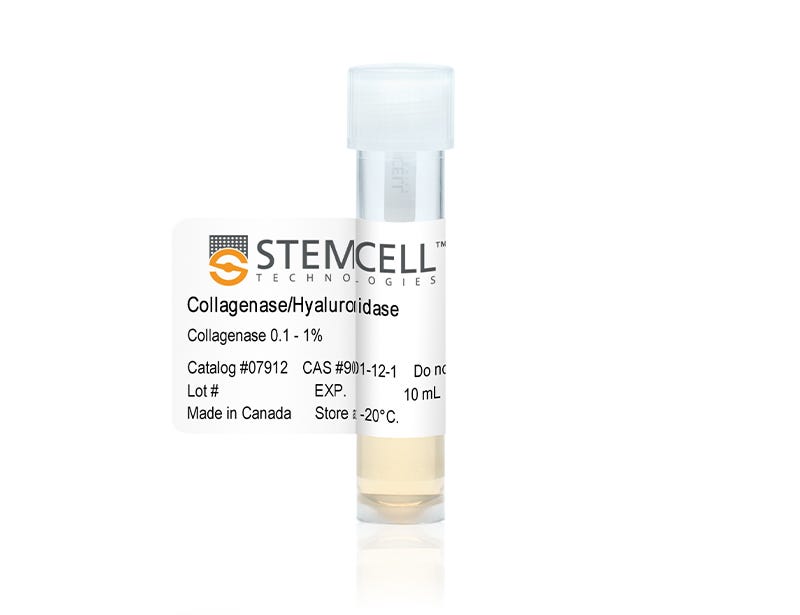
10X Collagenase/hyaluronidase in DMEM

Collagenase/Hyaluronidase

10X Collagenase/hyaluronidase in DMEM
From: 314 USD
Catalog #
(Select a product)
10X Collagenase/hyaluronidase in DMEM
Add to Wish List

Product Advantages


  • Effectively dissociate human mammary tissue and prostate epithelial cells

Overview

Enzymatically dissociate human mammary cells with 10X Collagenase/Hyaluronidase in Dulbecco’s Modified Eagle’s Medium (DMEM). This protease/polysaccharidase combination digests native collagen fibrils and hydrolizes hyaluronic acids in connective tissues for effective tissue dissociation. Collagenase/Hyluronidase can also been used for enzymatic dissociation of prostate epithelial cells.
Contains
• 3000 U/mL Collagenase
• 1000 U/mL Hyaluronidase
• DMEM (1000 mg D-glucose/L)
Subtype
Enzymatic
Cell Type
Mammary Cells, Other, Prostate Cells
Species
Human, Mouse, Non-Human Primate, Other, Rat
Application
Cell Culture
Area of Interest
Epithelial Cell Biology

Protocols and Documentation

Find supporting information and directions for use in the Product Information Sheet or explore additional protocols below.

Document Type
Product Name
Catalog #
Lot #
Language
Catalog #
07912
Lot #
All
Language
English
Document Type
Safety Data Sheet
Catalog #
07912
Lot #
All
Language
English

Applications

This product is designed for use in the following research area(s) as part of the highlighted workflow stage(s). Explore these workflows to learn more about the other products we offer to support each research area.

Resources and Publications

Publications (28)

Therapeutic Effects of Scutellaria baicalensis Georgi Extract and Baicalein on Olfactory Dysfunction and Neurobehavioral Alterations in a Methimazole-Induced Injury Model. M. Dao et al. Life (Basel, Switzerland) 2026 Jun

Abstract

BACKGROUND: Olfactory dysfunction is a pathology associated with viral infections, toxic damage, aging, and neurodegenerative diseases. Damage to the olfactory epithelium impairs olfactory function and related neurological behaviors. This study evaluated the restorative effects of Scutellaria baicalensis Georgi (SBG) extract and baicalein in a methimazole-induced olfactory dysfunction model. METHODS: Olfactory epithelial damage was induced in mice with methimazole, followed by treatment with SBG extract or baicalein. Olfactory and neurobehavioral functions were assessed using odor-finding, novel object recognition (NOR), Morris water maze (MWM), open field (OFT), and elevated plus maze tests (EPM). Histological, immunohistochemical, and in vitro analyses were performed to evaluate epithelial regeneration, mature olfactory sensory neurons (OSNs) expressing olfactory marker protein (OMP), and proliferative activity. RESULTS: Methimazole induced severe olfactory epithelial damage, impairing olfactory behavior and reducing learning and memory. Treatment with SBG extract and baicalein significantly improved olfactory and cognitive functions. Histological and immunohistochemical analyses confirmed restoration of epithelial structure and olfactory neurons. In vitro, SBG extract increased epithelial cell density and modulated proliferative activity. CONCLUSIONS: SBG extract and baicalein promote recovery of olfactory function and improve neurobehavioral outcomes, indicating their potential as therapies for olfactory dysfunction.
WSB1-Mediated PSMA Ubiquitination Promotes Enzalutamide-Induced Neuroendocrine-like Transition in Patient-Derived Prostate Cancer Spheroids. D. Jung et al. International journal of molecular sciences 2026 Aug

Abstract

Long-established prostate cancer cell lines provide limited insight into how contemporary early prostate cancer evolves into drug-resistant and neuroendocrine-like refractory disease. Patient-derived three-dimensional (3D) ex vivo models may better preserve this transition. Here, we found that 8 of 10 magnetic resonance imaging-guided biopsy specimens from patients with early-stage prostate cancer generated sustained 3D tumor spheroid cultures. After 12 weeks of enzalutamide selection, only one patient-derived culture acquired a resistant phenotype with treatment-emergent neuroendocrine prostate cancer (t-NEPC)-like features, including increased chromogranin A (CgA) and synaptophysin (SYP); reduced androgen receptor (AR), prostate-specific antigen (PSA), and prostate-specific membrane antigen (PSMA); and conversion from compact spheroids into irregular resistant aggregates. During this transition, WD repeat and SOCS box-containing protein 1 (WSB1) increased, whereas PSMA progressively decreased. WSB1 silencing restored PSMA, AR, and PSA expression and reduced neuroendocrine-associated features. A similar WSB1 dependency was observed in enzalutamide-resistant LNCaP cells, the castration-resistant prostate cancer model 22Rv1, and the neuroendocrine/small-cell prostate cancer model NCI-H660. Mechanistically, WSB1 functioned as a SOCS box-dependent E3 ubiquitin ligase adaptor that promoted PSMA ubiquitination and degradation. SOCS box deletion or T380A mutation impaired this process, while Aurora kinase A (AURKA) inhibition reduced WSB1-dependent PSMA ubiquitination. WSB1 depletion, AURKA inhibition with alisertib, and combined AURKA inhibition with EZH2 suppression reduced resistant aggregate growth and increased apoptosis-associated markers in patient-derived enzalutamide-resistant neuroendocrine-like spheroids and related models. These findings nominate the AURKA-WSB1-PSMA axis as a therapeutic vulnerability in refractory prostate cancer.
Prolactin and DNA damage trigger an anti-breast cancer cell immune response Ö. Karayazi Atici et al. Frontiers in Endocrinology 2025 Sep

Abstract

IntroductionThe role of prolactin (PRL) in breast cancer and its role within the context of the tumor microenvironment are not well understood. In our previous study, we demonstrated a cross-talk between the ataxia telangiectasia-mutated (ATM) DNA damage response pathway and the PRL-Janus-kinase-2 (JAK2)-signal transducer and activator of transcription-5 (STAT5)-heat shock protein-90 (HSP90) pathway. Here we investigated the role of PRL in tumor initiation and the effect of DNA damage.MethodsWe used an in vivo model to assess the ability of breast cancer cells to initiate orthotopic xenograft tumor formation after DNA damage. Breast cancer cells engineered to secrete human PRL were treated with the DNA damaging agent doxorubicin and injected into the mammary fat pad of immune-deficient severe combined immunodeficiency disease (SCID) mice.ResultsDoxorubicin and PRL combination increased the tumor latency, although PRL secretion alone did not change the tumor latency compared to the controls. Depletion of glycolipid asialo ganglioside-GM1-positive immune cells using anti-asialo GM1 antibody resulted in faster tumor formation only in the PRL-secreting breast cancer cells that were pre-treated with doxorubicin. Additionally, doxorubicin plus the PRL treatment of breast cancer cells was shown in vitro to attract cytotoxic NK cells compared to the controls, and this was dependent on the PRLR.DiscussionThese results demonstrate that combined breast cancer cell DNA damage and PRL exposure results in the anti-tumor cell activity of asialo-GM1-positive immune cells.