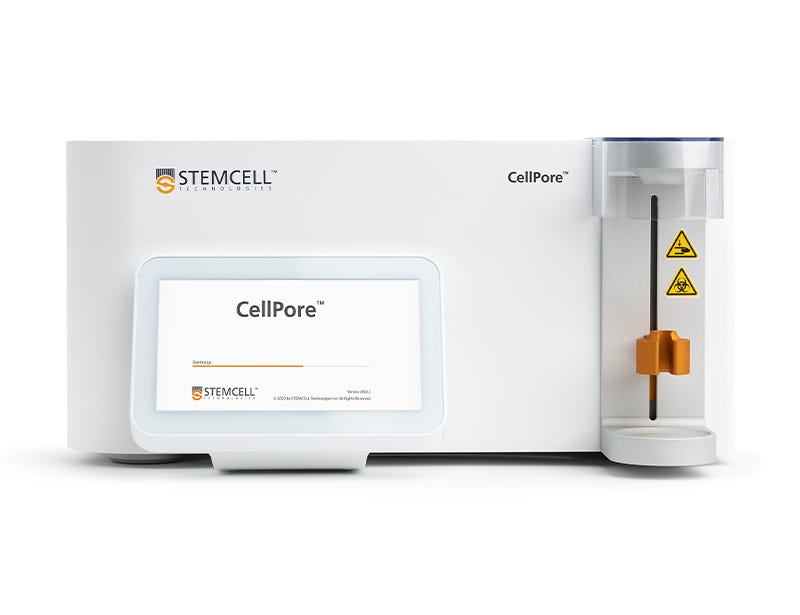
CellPore™ Transfection System

Cell mechanoporation system for transfection & intracellular delivery
CellPore™ Software Version 1.1.0 is now available. For instructions on how to download the update, please visit our Instrument Service Page.

For cartridge selection and optimized operating parameters, refer to the CellPore™ Mechanoporation Guide.

CellPore™ Transfection System

Cell mechanoporation system for transfection & intracellular delivery

From: 27,995 USD
Catalog #
(Select a product)
Cell mechanoporation system for transfection & intracellular delivery
Add to Wish List

Product Advantages

  • Achieve high delivery and viability for your cells
  • Fine-tune a single parameter to identify optimal delivery and viability conditions
  • Deliver cargoes intracellularly without altering cell quality
  • Transfect up to 10 million cells per second
  • Deliver a wide variety of cargoes to a broad range of cell types
Products for Your Protocol
To see all required products for your protocol, please consult the Protocols and Documentation.

What Our Scientist Says

As scientists dedicated to helping our peers overcome challenges with intracellular delivery, our dissatisfaction with existing tools drove us to develop this high-performance, user-friendly microfluidic transfection system. The CellPore™ Transfection System was designed to empower scientists to unlock new possibilities and set new standards for cell engineering applications.

Eric Ouellet, PhD Senior Scientist
Eric Ouellet, Senior Scientist

Overview

Achieve efficient cytosolic delivery of target cargoes (e.g. nucleic acids, proteins, and small molecules) into hard-to-transfect cell types such as human unactivated T cells, natural killer (NK) cells, hematopoietic stem and progenitor cells (HSPCs), and human pluripotent stem cells (hPSCs), without altering cell quality, using the CellPore™ Transfection System.

This easy-to-use system offers customization and flexibility for delivering a range of cargoes into specific cell types with minimal cell perturbations. It can help you achieve superior viability and delivery compared to other cell transfection methods, all with minimal protocol adjustments and seamless integration into existing workflows. The CellPore™ Transfection System is a microfluidic platform that uses compressed air* to rapidly squeeze cells through parallel microfluidic channels. This proprietary Cell Squeeze™ mechanoporation technology transiently disrupts the cell membrane, facilitating the intracellular delivery of target cargoes directly into the cytosol while preserving cell viability.

*Note that a compressed air cylinder is required to operate the instrument, and is not included. It must be purchased separately from a third-party supplier, which can be found under CellPore™ Transfection System Accessories.

Each new instrument purchase includes a one-year warranty covering parts, labor, and travel, with options to extend coverage and add preventative maintenance, installation and operation qualification, performance verification, and other additional services. To learn more, browse instrument services for the CellPore™ Transfection System, including warranty coverage, additional service packages, user-downloadable software updates, and the current software version. Whether you are adding instrumentation to a single step or connecting multiple systems, STEMCELL Technologies provides laboratory instruments that integrate seamlessly into a wide range of cell-based workflows.
Application
Genome Editing
Brand
CellPore
Area of Interest
Disease Modeling, Immunology, Cell Therapy Development

Data Figures

CellPore™ Enables Efficient Delivery of Cargo to Primary Immune Cells, Stem Cells, and Cell Lines

Figure 1. CellPore™ Enables Efficient Delivery of Cargo to Primary Immune Cells, Stem Cells, and Cell Lines

Cells were resuspended in appropriate CellPore™ Delivery Media and transfected using the CellPore™ Transfection System. (A) Cas9 RNPs targeting TRAC (TCRɑβ), B2M (MHC-I), CIITA (MHC-II), TIGIT (TIGIT), KLRC1 (NKG2A), or PTPRC (CD45) were successfully delivered to various primary immune cells, stem cells, and immortalized cell lines, resulting in the knockout of their respective surface marker with minimal impact to cell viability (relative to untreated controls). (B) Representative flow plot of co-delivery of mCherry and eGFP mRNA to human unactivated T cells, which resulted in over 90% co-expression of both constructs. (C) Delivery of a self-amplifying RNA construct encoding GFP (1.5 pmol, 5 μg) to human CD34+ hematopoietic stem & progenitor cells resulted in successful GFP expression expansion over 7 days (with 0.8 μg/mL puromycin; n = 2). (D) Delivery of a 3.5 Kb GFP-encoding plasmid DNA to Jurkats resulted in dose-dependent increase in GFP expression and maintenance of high viability (n = 4-6). Results measured via flow cytometry. Untreated refers to unmanipulated cells. No Cargo control refers to cells mechanoporated without cargo. Data presented as mean ± SD.

CellPore™ Mechanoporation Performance in Human Unactivated T cells

Figure 2. CellPore™ Mechanoporation Performance in Human Unactivated T cells

All experiments were performed using CellPore™ Delivery Cartridge 300 and CellPore™ Delivery Medium A with 2x10⁶ cells per 50 μL reaction. (A) FITC-Dextran (0.1 mg/mL) was delivered across a range of pressures, and optimal intracellular cargo delivery and cell viability were measured between 70 - 90 psi (n = 7). (B) Independent or co-delivery of eGFP and mCherry mRNA (15 pmol, each) at 90 psi resulted in high expression efficiency (> 90%) across T cell subsets, measured by flow cytometry 24 hours post-mechanoporation (n = 3). (C) Cas9 RNPs (60 pmol; 1:2.5 Cas9:gRNA) targeting B2M (MHC-I) or TRAC (TCRɑβ) were delivered at 90 psi, resulting in > 80% surface marker knockout efficiency while retaining high cell viability (n = 5). “Untreated” refers to unmanipulated cells. Endocytosis control represents natural uptake of FITC-Dextran in unmanipulated cells. Results were measured by flow cytometry. Data presented as mean ± SD.

CellPore™ Mechanoporation Performance in Human Peripheral Blood Natural Killer cells

Figure 3. CellPore™ Mechanoporation Performance in Human Peripheral Blood Natural Killer cells

All experiments were performed using Delivery Cartridge 300 and Delivery Medium A with 2x10⁶ cells per 50 μL reaction. (A) FITC-Dextran (0.1 mg/mL) was delivered across a range of pressures, and optimal intracellular cargo delivery and cell viability were measured between 70 - 90 psi (n = 5). (B) Titration of mCherry mRNA delivered at 70 psi resulted in high expression efficiency (> 90%) above 6 pmol, as measured by flow cytometry 24 hours post-mechanoporation (n = 2). (C) Fresh NK cells isolated from peripheral blood were cultured in ImmunoCult™ NK Base Medium supplemented with 10 ng/mL IL-2 overnight prior to Cas9 RNP delivery (60 pmol, 1:2.5 Cas9:gRNA). RNPs targeting TIGIT (TIGIT), FCGR3 (CD16), KLRC1 (NKG2A), or NCR1 (NKp46) genes were delivered at 70 psi, resulting in knockout of their respective surface markers (n = 3 - 8). Results were measured by flow cytometry. “Untreated” refers to unmanipulated cells. Endocytosis control represents natural uptake of FITC-Dextran in unmanipulated cells. Data presented as mean ± SD.

CellPore™ Mechanoporation Performance in Human Peripheral Blood Monocytes

Figure 4. CellPore™ Mechanoporation Performance in Human Peripheral Blood Monocytes

All experiments were performed using Delivery Cartridge 400 and Delivery Medium A with 1x10⁶ - 2x10⁶ cells per 50 μL reaction. (A) FITC-Dextran (0.1 mg/mL) was delivered across a range of pressures, and optimal intracellular cargo delivery and cell viability were measured at 50 psi (n = 3). (B) Delivery of eGFP mRNA (1 Kb) at 50 psi showed optimal expression at 7.5 pmol, measured by flow cytometry 24 hours post-mechanoporation (n = 3 - 7). (C) Cas9 RNPs (60 pmol; 1:2.5 Cas9:gRNA) targeting B2M (MHC-I) or CIITA (MHC-II) were delivered at 50 psi, resulting in > 80% surface marker knockout efficiency while retaining high cell viability. Cells were cultured at 1x10⁶ cells/mL in ImmunoCult™ Dendritic Cell Culture Kit for 7 days before analysis by flow cytometry (n = 3 - 4). “Untreated” refers to unmanipulated cells. Endocytosis control represents natural uptake of FITC-Dextran in unmanipulated cells. Data presented as mean ± SD.

CellPore™ Mechanoporation Performance in Human CD34+ Hematopoietic Stem and Progenitor Cells

Figure 5. CellPore™ Mechanoporation Performance in Human CD34+ Hematopoietic Stem and Progenitor Cells

All experiments were performed using Delivery Cartridge 300 and Delivery Medium A with 5x10⁴ cells per 80 μL reaction. (A) FITC-Dextran (0.1 mg/mL) was delivered across a range of pressures, and optimal intracellular cargo delivery and cell viability were measured at 30 psi (n = 3 - 6). (B) Delivery of eGFP mRNA (1 Kb) at 30 psi showed optimal expression above 6 pmol, measured by flow cytometry 24 hours post-mechanoporation (n = 3). (C) Delivery of Cas9 RNPs (40 pmol; 1:2.5 Cas9:gRNA) targeting B2M and PTPRC at 30 psi resulted in efficient knockout of MHC-I and CD45 surface markers, respectively (n = 3 - 4). Results were measured by flow cytometry. “Untreated” refers to unmanipulated cells. Endocytosis control represents natural uptake of FITC-Dextran in unmanipulated cells. Data presented as mean ± SD.

CellPore™ Mechanoporation Performance in Human Pluripotent Stem Cells

Figure 6. CellPore™ Mechanoporation Performance in Human Pluripotent Stem Cells

All experiments were performed using Delivery Cartridge 500 and Delivery Medium B with 3.5x10⁵ cells per 50 μL reaction. (A) FITC-Dextran (0.1 mg/mL) was delivered across a range of pressures to the H9 Embryonic Stem Cell line, and optimal delivery and cell viability was measured at 15 psi (n = 3). (B) Delivery of eGFP mRNA (7.5 pmol) at 15 psi across 3 hPSC lines (H9, WLS-1C, SCTi003-A) resulted in high expression efficiency (> 95%), measured by flow cytometry 48 hours post-mechanoporation. Viability was comparable to untreated conditions (n = 4 - 8). (C) Delivery of Cas9 RNPs (60 pmol; 1:2.5 Cas9:gRNA) targeting B2M at 15 psi across 3 hPSC lines resulted in robust MHC-I surface marker knockout efficiencies and retention of high cell viability (n = 8 - 11). Results were measured by flow cytometry. Untreated refers to unmanipulated cells. Endocytosis control represents natural uptake of FITC-Dextran in unmanipulated cells. Data presented as mean ± SD.

CellPore™ Mechanoporation Performance in Unactivated Mouse T cells Isolated from Spleens

Figure 7. CellPore™ Mechanoporation Performance in Unactivated Mouse T cells Isolated from Spleens

All experiments were performed using Delivery Cartridge 300 and Delivery Medium A with 2x10⁶ cells per 50 μL reaction. (A) Cell viability and FITC Dextran delivery (0.1 mg/mL) were evaluated across 30 - 60 psi, with optimal performance measured at 50 psi (n = 7 - 10). (B) Delivery of Cas9 RNPs (60 pmol; 1:2.5 Cas9:gRNA) targeting Thy1 to mouse T cells yielded robust CD90 surface marker knockout by Day 7. Flow cytometry showed only minor viability changes compared to an untreated control (n = 3). “Untreated” refers to unmanipulated cells, Scramble control represents delivery of a non-targeting RNP. Endocytosis control represents natural uptake of FITC-Dextran in unmanipulated cells. Data presented as mean ± SD.

CellPore™ Mechanoporation Performance in Jurkat cells

Figure 8. CellPore™ Mechanoporation Performance in Jurkat cells

All experiments were performed using Delivery Cartridge 300 and Delivery Medium A with 1x10⁶ cells per 50 μL reaction. (A) FITC-Dextran (0.1 mg/mL) was delivered across a range of pressures, and optimal intracellular cargo delivery was measured at 30 psi (n = 2). (B) Delivery of Cas9 RNP (40 pmol; 1:2.5 cas9:gRNA) targeting the TRAC gene at 30 psi resulted in highly efficient surface TCRɑꞵ gene knockout and retention of high viability (n = 3). (C) Delivery of a 3.5 Kb GFP-encoding plasmid DNA at 30 psi resulted in dose-dependent increase in GFP expression and maintenance of high viability (n = 4 - 6). Results were measured by flow cytometry. “Untreated” refers to unmanipulated cells. Endocytosis control represents natural uptake of FITC-Dextran in unmanipulated cells. Data presented as mean ± SD.

Protocols and Documentation

Find supporting information and directions for use in the Product Information Sheet or explore additional protocols below.

Document Type
Product Name
Catalog #
Lot #
Language
Document Type
Technical Manual
Catalog #
100-0946
Lot #
All
Language
English

Resources and Publications

Educational Materials (16)

CellPore™ Software Version 1.1.0 is now available. For instructions on how to download the update, please visit our Instrument Service Page.

For cartridge selection and optimized operating parameters, refer to the CellPore™ Mechanoporation Guide.