NeuroCult® Proliferation Supplement (Mouse)

? 1.800.667.0322   > Contact Us

Supplement for Expansion of Mouse Neural Stem and Progenitor Cells


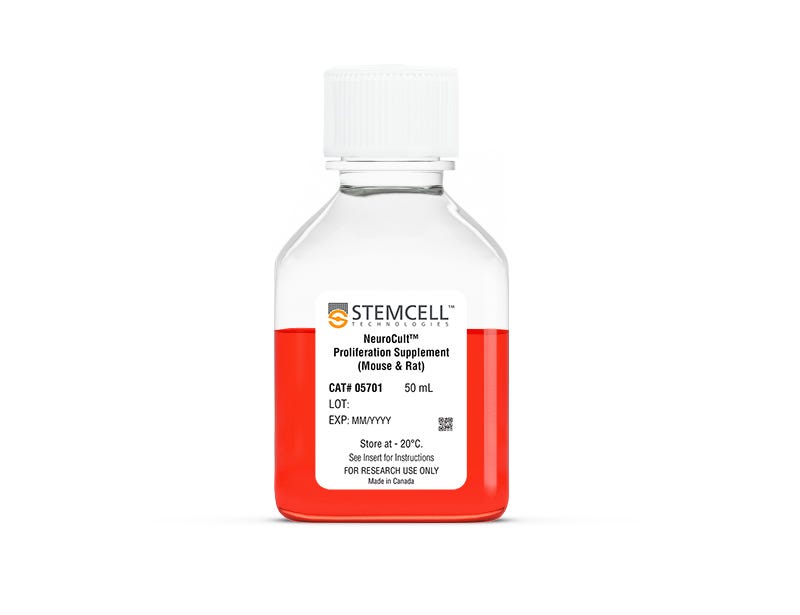
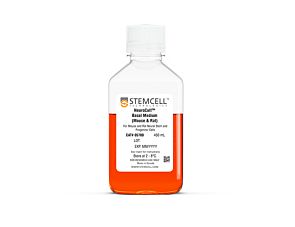
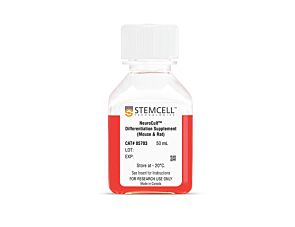
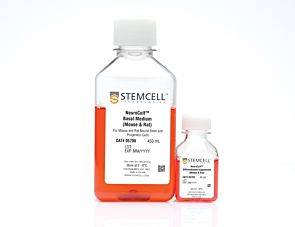
  • NeuroCult® Neural Stem Cell Proliferation Supplement (Mouse) 50 mL
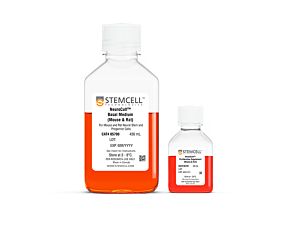
  • Label for NeuroCult® Neural Stem Cell Proliferation Supplement (Mouse) 50 mL
NeuroCult® Neural Stem Cell Proliferation Supplement (Mouse) 50 mL
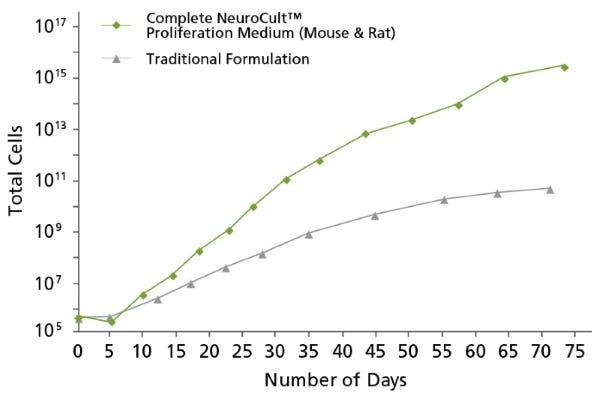
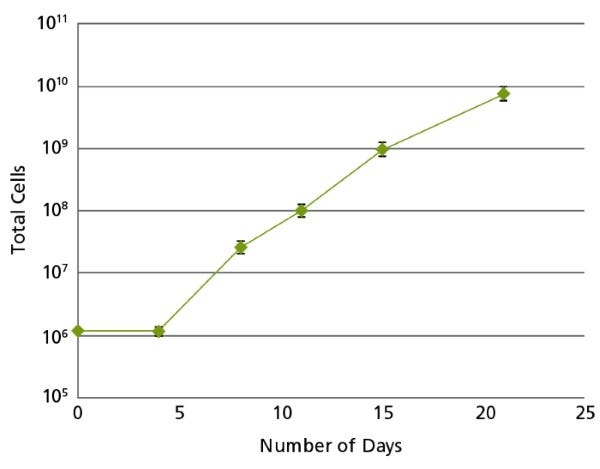
NeuroCult® NSC Proliferation Supplement (Mouse) is a standardized, serum-free supplement for the culture of mouse neural stem and progenitor cells. NeuroCult® NSC Proliferation Supplement (Mouse) is designed to be combined with NeuroCult® NSC Basal Medium (Mouse; Catalog #05700) and appropriate cytokines (not included). NeuroCult® NSC Proliferation Supplement (Mouse) is optimized to maintain mouse neural stem cells in culture for extended periods of time without the loss of their self-renewal, proliferation or differentiation potential. This supplement is also a component of the NeuroCult® NSC Proliferation Kit (Mouse; Catalog #05702).
 
NOTE: When preparing Complete NeuroCult® Proliferation Medium (Mouse), addition of rh EGF (Catalog #02633) is required. When culturing cells obtained from adult mouse, rh bFGF (Catalog #02634) and heparin (Catalog #07980) are also required.
Product Name Description Catalog # Size Price Quantity
NeuroCult® Proliferation Supplement (Mouse) Supplement for expansion of mouse neural stem and progenitor cells 05701 50 mL 111.00 USD      
 Save Item

Order Offline:

Call us: +1.604.877.0713  
Toll Free: 1.800.667.0322  
Email us:
 
Fax us: +1.604.877.0704
Toll Free Fax: 1.800.567.2899

Recommended for:
• Expansion of embryonic and adult mouse neural stem and progenitor cells as neurospheres or adherent monolayers when combined with NeuroCult® NSC Basal Medium (Mouse; Catalog #05700) and appropriate cytokines
• Clonal and bulk isolation and propagation of embryonic and adult mouse neural stem and progenitor cells when combined with NeuroCult® NSC Basal Medium (Mouse; Catalog #05700) and appropriate cytokines
• NOTE: When preparing Complete NeuroCult® Proliferation Medium (Mouse), addition of rh EGF (Catalog #02633) is required. When culturing cells obtained from adult mouse, rh bFGF (Catalog #02634) and heparin (Catalog #07980) are also required.
 
Components:
N/A
Accessory Products:
• NeuroCult® NSC Basal Medium (Mouse; Catalog #05700)
• EGF, Human, Recombinant (Catalog #02633)
• bFGF, Human, Recombinant (Catalog #02634)
• Heparin (Catalog #07980)
Intended Use Statement: For Research Use Only. Not for Therapeutic or Diagnostic Use.
Contains:
Legal Statement: Sold under license from StemCells California, Inc. US Patent Nos. 5,750,376; 5,851,832; 5,980,885; 5,968,829; 5,981,165; 6,071,889; 6,093,531; 6,103,530; 6,165,783; 6,238,922.
Product Type: Specialized cell culture media
Application: Expansion
Area of Interest: Neuroscience, Stem cell biology
Medium Type: Serum-free
Popular Product Line: NeuroCult
Species: Mouse

This product has been used in:

  1. Massimo Squatrito et al. Loss of ATM/Chk2/p53 Pathway Components Accelerates Tumor Development and Contributes to Radiation Resistance in Gliomas.Cancer Cell 18 (6) 619-629 (December 14, 2010)
  2. Hongwu Zheng et al. PLAGL2 regulates Wnt signaling to impede differentiation in neural stem cells and gliomas.Cancer Cell 17 (5) 497-509 (May 18, 2010)
  3. Areechun Sotthibundhu et al. Abeta(1-42) stimulates adult SVZ neurogenesis through the p75 neurotrophin receptor.Neurobiol Aging 30 (12) 1975-1985 (December 2009)
  4. Evan Elliott et al. BAG-1 is preferentially expressed in neuronal precursor cells of the adult mouse brain and regulates their proliferation in vitro.FEBS Lett 583 (1) 229-234 (January 5, 2009)
  5. Celine Mathieu et al. Endothelial cell-derived bone morphogenetic proteins control proliferation of neural stem/progenitor cells.Molecular and cellular neurosciences 38 (4) 569-577 (August 2008)
  6. Yun Li et al. TrkB regulates hippocampal neurogenesis and governs sensitivity to antidepressive treatment.Neuron 59 (3) 399-412 (August 14, 2008)
  7. Zeng-Jie Yang et al. Medulloblastoma can be initiated by deletion of Patched in lineage-restricted progenitors or stem cells.Cancer Cell 14 (2) 135-145 (August 12, 2008)
  8. Sharon A Louis et al. Enumeration of neural stem and progenitor cells in the neural colony-forming cell assay.Stem Cells 26 (4) 988-996 (April 2008)
  9. Yoko Ishii et al. Characterization of neuroprogenitor cells expressing the PDGF beta-receptor within the subventricular zone of postnatal mice.Mol Cell Neurosci 37 (3) 507-518 (March 2008)
  10. Karine Sii-Felice et al. Fanconi DNA repair pathway is required for survival and long-term maintenance of neural progenitors.EMBO J 27 (5) 770-781 (March 5, 2008)
  11. Takahiro Yasuda et al. K(ir) and K(v) channels regulate electrical properties and proliferation of adult neural precursor cells.Mol Cell Neurosci 37 (2) 284-297 (February 2008)
  12. Kaylene M Young et al. Subventricular zone stem cells are heterogeneous with respect to their embryonic origins and neurogenic fates in the adult olfactory bulb.J Neurosci 27 (31) 8286-8296 (August 1, 2007)
  13. Eiji Mizutani et al. Developmental ability of cloned embryos from neural stem cells.Reproduction 132 (6) 849-857 (December 2006)
  14. D P Fitzgerald et al. Characterization of neogenin-expressing neural progenitor populations and migrating neuroblasts in the embryonic mouse forebrain.Neuroscience 142 (3) 703-716 (October 27, 2006)
  15. Sung-Jo Kim et al. Palmitoyl-protein thioesterase-1 deficiency leads to the activation of caspase-9 and contributes to rapid neurodegeneration in INCL.Hum Mol Genet 15 (10) 1580-1586 (May 15, 2006)
  16. Jun Udagawa et al. The role of leptin in the development of the cerebral cortex in mouse embryos.Endocrinology 147 (2) 647-658 (February 2006)
  17. Turhan Coksaygan et al. Neurogenesis in Talpha-1 tubulin transgenic mice during development and after injury.Exp Neurol 197 (2) 475-485 (February 2006)
  18. Satoshi Kishigami et al. Significant improvement of mouse cloning technique by treatment with trichostatin A after somatic nuclear transfer.Biochem Biophys Res Commun 340 (1) 183-189 (February 3, 2006)
  19. Toshiyuki Ohtsuka et al. Visualization of embryonic neural stem cells using Hes promoters in transgenic mice.Mol Cell Neurosci 31 (1) 109-122 (January 2006)
  20. M Kucia et al. Cells enriched in markers of neural tissue-committed stem cells reside in the bone marrow and are mobilized into the peripheral blood following stroke.Leukemia 20 (1) 18-28 (January 2006)
  21. Zhongjian Zhang et al. Palmitoyl-protein thioesterase-1 deficiency mediates the activation of the unfolded protein response and neuronal apoptosis in INCL.Hum Mol Genet 15 (2) 337-346 (January 15, 2006)
  22. Viviane El-Helou et al. Resident nestin+ neural-like cells and fibers are detected in normal and damaged rat myocardium.Hypertension 46 (5) 1219-1225 (November 2005)
  23. Natalie D Bull et al. The adult mouse hippocampal progenitor is neurogenic but not a stem cell.J Neurosci 25 (47) 10815-10821 (November 23, 2005)
  24. Pasan Fernando et al. Neural stem cell differentiation is dependent upon endogenous caspase 3 activity.FASEB J 19 (12) 1671-1673 (October 2005)
  25. Christine Y Brazel et al. Sox2 expression defines a heterogeneous population of neurosphere-forming cells in the adult murine brain.Aging Cell 4 (4) 197-207 (August 2005)
  26. M Kucia et al. Bone marrow as a home of heterogenous populations of nonhematopoietic stem cells.Leukemia 19 (7) 1118-1127 (July 2005)

Background References:

  1. B A Reynolds et al. Clonal and population analyses demonstrate that an EGF-responsive mammalian embryonic CNS precursor is a stem cell.Dev Biol 175 (1) 1-13 (April 10, 1996)

Product Name

Description

Catalog #

NeuroCult® Basal Medium (Mouse) Basal Medium for Mouse Neural Stem and Progenitor Cells 05700
EGF, Human, Recombinant Epidermal Growth Factor 02633
bFGF, Human, Recombinant Basic Fibroblast Growth Factor (bFGF) 02634
0.2% Heparin Sodium Salt in PBS 0.2% Heparin Sodium Salt in Phosphate Buffered Saline 07980