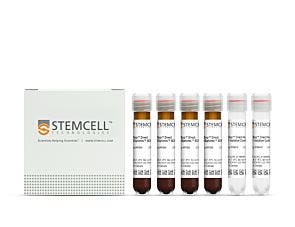
RosetteSep® Human T Cell Enrichment Cocktail

? 1.800.667.0322   > Contact Us

Immunodensity Negative Selection Cocktail


Free from STEMCELL

  • RosetteSep® Box
  • Box top label for Human T Cell Enrichment Cocktail For labeling 40 mL blood
  • Box top label for Human T Cell Enrichment Cocktail For labeling 200 mL blood
RosetteSep® Box
The RosetteSep® Human T Cell Enrichment Cocktail is designed to isolate T cells from whole blood by negative selection. Unwanted cells are targeted for removal with Tetrameric Antibody Complexes recognizing CD16, CD19, CD36, CD56, CD66b and glycophorin A on red blood cells (RBCs). When centrifuged over a buoyant density medium such as RosetteSep® DM-L (Catalog #15705) or Ficoll-Paque™ PLUS (Catalog #07957), the unwanted cells pellet along with the RBCs. The purified T cells are present as a highly enriched population at the interface between the plasma and the buoyant density medium.
Product Name Description Catalog # Size Price Quantity
RosetteSep® Human T Cell Enrichment Cocktail Immunodensity isolation of untouched T cells 15061 For labeling 200 mL of whole blood 576.00 USD      
 Save Item
RosetteSep® Human T Cell Enrichment Cocktail Immunodensity isolation of untouched T cells 15021 For labeling 40 mL of whole blood 149.00 USD      
 Save Item

Order Offline:

Call us: +1.604.877.0713  
Toll Free: 1.800.667.0322  
Email us:
 
Fax us: +1.604.877.0704
Toll Free Fax: 1.800.567.2899

Recommended for:
The isolation of human T cells from whole blood by negative selection
Components:
RosetteSep® Human T Cell Enrichment Cocktail
Accessory Products:
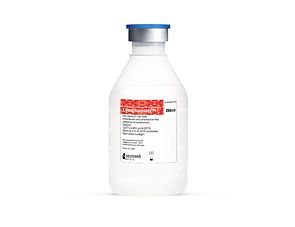
• Ficoll-Paque™ PLUS (Catalog #07957), or
• RosetteSep® DM-L (Catalog #15705)
Intended Use Statement: For Research Use Only. Not for Therapeutic or Diagnostic Use.
Legal Statement: Ficoll-Paque™ PLUS is a trademark of GE Healthcare Ltd.
Product Type: Cell isolation products
Area of Interest: HIV, Immunology
Cell Isolation Product Type: Reagents
Cell Source: Buffy coat, Whole blood
Cell Type: T cells
Popular Product Line: RosetteSep
Selection Method: Negative
Species: Human

Procedures and instruction manuals:

Educational resources:

MSDS:

FAQS:


  • HOW ROSETTESEP™ WORKS

    • Q. WHAT IS ROSETTESEP™?
      A. RosetteSep™ is a rapid cell separation procedure for the isolation of purified cells directly from whole blood, without columns or magnets.
    • Q. HOW DOES ROSETTESEP™ WORK?
      A. The antibody cocktail crosslinks unwanted cells to red blood cells (RBCs), forming rosettes. The unwanted cells then pellet with the free RBCs when centrifuged over a density centrifugation medium (e.g. Ficoll-Paque™ PLUS, Lymphoprep™).
    • Q. WHAT FACTORS AFFECT CELL RECOVERY?
      A. The temperature of the reagents can affect cell recovery. All reagents should be at room temperature (sample, density centrifugation medium, PBS, centrifuge) before performing the isolations. Layering can also affect recovery so be sure to carefully layer the sample to avoid mixing with the density centrifugation medium as much as possible. Be sure to collect the entire enriched culture without disturbing the RBC pellet. A small amount of density centrifugation medium can be collected without worry.

    CELL TYPES AND SAMPLE SOURCES

    • Q. WHICH CELL SAMPLES CAN ROSETTESEP™ BE USED WITH?
      A. RosetteSep™ can be used with leukapheresis samples, bone marrow or buffy coat, as long as: the concentration of cells does not exceed 5 x 10⁷ per mL (can dilute if necessary); and there are at least 20 RBCs for every nucleated cell (RBCs can be added if necessary).
    • Q. CAN ROSETTESEP™ BE USED WITH PREVIOUSLY FROZEN OR CULTURED CELLS?
      A. Yes. Cells should be re-suspended at 2 - 5 x 10⁷ cells / mL in PBS + 2% FBS. Fresh whole blood should be added at 250 µL per mL of sample, as a source of red cells.
    • Q. CAN ROSETTESEP™ BE USED TO ENRICH PROGENITORS FROM CORD BLOOD?
      A. Yes. Sometimes cord blood contains immature nucleated red cells that have a lower density than mature RBCs. These immature red cells do not pellet over Ficoll™, which can lead to a higher RBC contamination than peripheral blood separations.
    • Q. DOES ROSETTESEP™ WORK WITH MOUSE CELLS?
      A. No, but we have developed EasySep™, a magnetic-based cell isolation system which works with mouse and other non-human species.

    ANTI-COAGULANTS

    • Q. WHICH ANTICOAGULANT SHOULD BE USED WITH ROSETTESEP™?
      A. Peripheral blood should be collected in heparinized Vacutainers. Cord blood should be collected in ACD.
    • Q. SHOULD THE ANTICOAGULANT BE WASHED OFF BEFORE USING ROSETTESEP™?
      A. No, the antibody cocktail can be added directly to the sample.

This product has been used in:

  1. Haik Mkhikian et al. Genetics and the environment converge to dysregulate N-glycosylation in multiple sclerosis.Nat Commun 2 334 (2011)
  2. Arne von Bonin et al. Inhibition of the IL-2-inducible tyrosine kinase (Itk) activity: a new concept for the therapy of inflammatory skin diseases.Exp Dermatol 20 (1) 41-47 (January 2011)
  3. Anita Parmigiani et al. Interleukin-21 and cellular activation concurrently induce potent cytotoxic function and promote antiviral activity in human CD8 T cells.Hum Immunol (October 25, 2010)
  4. Lee A Honigberg et al. The Bruton tyrosine kinase inhibitor PCI-32765 blocks B-cell activation and is efficacious in models of autoimmune disease and B-cell malignancy.Proc Natl Acad Sci U S A 107 (29) 13075-13080 (July 20, 2010)
  5. Jack Y Lee et al. Dynamic alterations in chemokine gradients induce transendothelial shuttling of human T cells under physiologic shear conditions.J Leukoc Biol 86 (6) 1285-1294 (December 2009)
  6. Cecilia Frecha et al. Efficient and stable transduction of resting B lymphocytes and primary chronic lymphocyte leukemia cells using measles virus gp displaying lentiviral vectors.Blood 114 (15) 3173-3180 (October 8, 2009)
  7. Jos?? C Crisp??n et al. Human TCR-alpha beta+ CD4- CD8- T cells can derive from CD8+ T cells and display an inflammatory effector phenotype.J Immunol 183 (7) 4675-4681 (October 1, 2009)
  8. Herve Benoist et al. Two structurally identical mannose-specific jacalin-related lectins display different effects on human T lymphocyte activation and cell deathJ Leukoc Biol 86 (1) 103-114 (July 1, 2009)
  9. Erin Kennah et al. Identification of tyrosine kinase, HCK, and tumor suppressor, BIN1, as potential mediators of AHI-1 oncogene in primary and transformed CTCL cells.Blood 113 (19) 4646-4655 (May 7, 2009)
  10. David M Lucas et al. The novel plant-derived agent silvestrol has B-cell selective activity in chronic lymphocytic leukemia and acute lymphoblastic leukemia in vitro and in vivo.Blood 113 (19) 4656-4666 (May 7, 2009)
  11. Katsue Sunahori et al. Methylation status of CpG islands flanking a cAMP response element motif on the protein phosphatase 2Ac alpha promoter determines CREB binding and activity.J Immunol 182 (3) 1500-1508 (February 1, 2009)
  12. Vaishali R Moulton et al. The RNA-stabilizing protein HuR regulates the expression of zeta chain of the human T cell receptor-associated CD3 complex.J Biol Chem 283 (29) 20037-20044 (July 18, 2008)
  13. Haifa Ghandour et al. Essential role for Rap1 GTPase and its guanine exchange factor CalDAG-GEFI in LFA-1 but not VLA-4 integrin mediated human T-cell adhesion.Blood 110 (10) 3682-3690 (November 15, 2007)
  14. Muzlifah A Haniffa et al. Adult human fibroblasts are potent immunoregulatory cells and functionally equivalent to mesenchymal stem cells.J Immunol 179 (3) 1595-1604 (August 1, 2007)
  15. Stella A Nicolaou et al. Altered dynamics of Kv1.3 channel compartmentalization in the immunological synapse in systemic lupus erythematosus.J Immunol 179 (1) 346-356 (July 1, 2007)
  16. Claudia S Wagner et al. Increased expression of leukocyte Ig-like receptor-1 and activating role of UL18 in the response to cytomegalovirus infection.J Immunol 178 (6) 3536-3543 (March 15, 2007)
  17. Kondala Atkuri et al. Importance of culturing primary lymphocytes at physiological oxygen levelsProceedings of the National Academy of Sciences 104 (11) (March 13, 2007)
  18. Kimberly N Kremer et al. Haplotype-independent costimulation of IL-10 secretion by SDF-1/CXCL12 proceeds via AP-1 binding to the human IL-10 promoter.J Immunol 178 (3) 1581-1588 (February 1, 2007)
  19. Yansong Li et al. Phosphorylated ERM is responsible for increased T cell polarization, adhesion, and migration in patients with systemic lupus erythematosus.J Immunol 178 (3) 1938-1947 (February 1, 2007)
  20. Yong-Tae Ahn et al. Dynamic interplay of transcriptional machinery and chromatin regulates "late" expression of the chemokine RANTES in T lymphocytes.Mol Cell Biol 27 (1) 253-266 (January 2007)
  21. Silvia Campello et al. Orchestration of lymphocyte chemotaxis by mitochondrial dynamicsThe Journal of Experimental Medicine 203 (13) (December 25, 2006)
  22. Montserrat Barragan et al. Regulation of Akt/PKB by phosphatidylinositol 3-kinase-dependent and -independent pathways in B-cell chronic lymphocytic leukemia cells: role of protein kinase C{beta}J Leukoc Biol 80 (6) 1473-1479 (December 1, 2006)
  23. Krzysztof Laudanski et al. Cell-specific expression and pathway analyses reveal alterations in trauma-related human T cell and monocyte pathways.Proc Natl Acad Sci U S A 103 (42) 15564-15569 (October 17, 2006)
  24. Keiko Yoshimoto et al. Aberrant expression of BAFF in T cells of systemic lupus erythematosus, which is recapitulated by a human T cell line, Loucy.Int Immunol 18 (7) 1189-1196 (July 2006)
  25. Alexandra Zanin-Zhorov et al. Heat shock protein 60 enhances CD4+ CD25+ regulatory T cell function via innate TLR2 signaling.J Clin Invest 116 (7) 2022-2032 (July 2006)
  26. Jelena Tomic et al. Sensitization of IL-2 signaling through TLR-7 enhances B lymphoma cell immunogenicity.J Immunol 176 (6) 3830-3839 (March 15, 2006)
  27. Jung-Su Chang et al. Myobacterium tuberculosis induces selective up-regulation of TLRs in the mononuclear leukocytes of patients with active pulmonary tuberculosis.J Immunol 176 (5) 3010-3018 (March 1, 2006)
  28. Chiho Goda et al. Involvement of IL-32 in activation-induced cell death in T cells.Int Immunol 18 (2) 233-240 (February 2006)
  29. Jun Abe et al. Gene Expression Profiling of the Effect of High-Dose Intravenous Ig in Patients with Kawasaki DiseaseJ Immunol 174 (9) 5837-5845 (May 1, 2005)
  30. J Perren Cobb et al. Application of genome-wide expression analysis to human health and disease.Proc Natl Acad Sci U S A 102 (13) 4801-4806 (March 29, 2005)
  31. Michael R. Bishop et al. Targeted pretransplant host lymphocyte depletion prior to T-cell depleted reduced-intensity allogeneic stem cell transplantationBritish Journal of Haematology 126 (6) 837-843 (2004)
  32. Xiao-Song He et al. T cell-dependent production of IFN-gamma by NK cells in response to influenza A virus.J Clin Invest 114 (12) 1812-1819 (December 2004)
  33. Michael R Bishop et al. Allogeneic lymphocytes induce tumor regression of advanced metastatic breast cancer.J Clin Oncol 22 (19) 3886-3892 (October 1, 2004)
  34. Ravi M Rao et al. Elastase release by transmigrating neutrophils deactivates endothelial-bound SDF-1alpha and attenuates subsequent T lymphocyte transendothelial migration.J Exp Med 200 (6) 713-724 (September 20, 2004)
  35. Tara M C Hornell et al. Regulation of the class II MHC pathway in primary human monocytes by granulocyte-macrophage colony-stimulating factor.J Immunol 171 (5) 2374-2383 (September 1, 2003)
  36. Enli Liu et al. Discrimination of polycythemias and thrombocytoses by novel, simple, accurate clonality assays and comparison with PRV-1 expression and BFU-E response to erythropoietin.Blood 101 (8) 3294-3301 (April 15, 2003)
  37. Christine Beeton et al. A novel fluorescent toxin to detect and investigate Kv1.3 channel up-regulation in chronically activated T lymphocytes.J Biol Chem 278 (11) 9928-9937 (March 14, 2003)
  38. Laura Conforti et al. Hypoxia regulates expression and activity of Kv1.3 channels in T lymphocytes: a possible role in T cell proliferation.J Immunol 170 (2) 695-702 (January 15, 2003)
  39. Peter A Sieling et al. Toll-like receptor 2 ligands as adjuvants for human Th1 responses.J Immunol 170 (1) 194-200 (January 1, 2003)

Product Name

Description

Catalog #

CD3 Antibody, Clone SK7, PE-Conjugated Mouse Monoclonal Antibody to Human CD3 - PE Conjugated 10502
CD3 Antibody, Clone SK7, FITC-Conjugated Mouse Monoclonal Antibody to CD3 - FITC Conjugated 10402
Ficoll-Paque™ PLUS Density Gradient Medium for the Isolation of Mononuclear Cells 07907
HetaSep™ For Isolating Human Nucleated Cells from Peripheral Blood 07806
RosetteSep™ DM-L Density Medium Density Gradient Medium 15705

Typical RosetteSep® HLA T Cell Enrichment Profile


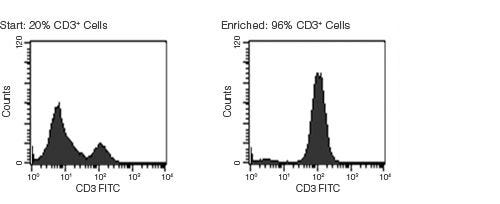
Typical RosetteSep® T Cell Enrichment Profile
Starting with fresh whole blood the CD3+ cell content of the enriched fraction typically ranges from 90% - 97%. Red blood cells were removed by lysis prior to flow cytometry.


RosetteSep® Procedure


RosetteSep® Procedure