MyeloCult™ H5100

Medium for long-term culture of human cells

MyeloCult™ H5100

Medium for long-term culture of human cells

From: 451 USD
Catalog #
(Select a product)
Medium for long-term culture of human cells
Add to Wish List

Overview

MyeloCult™ H5100 is a culture medium for the initiation and maintenance of myeloid long-term cultures of human hematopoietic cells and stromal cell feeder layers. The serum used in this formulation has been pre-tested and selected for its ability to support long-term myelopoiesis by primitive human hematopoietic cells (e.g. in long-term culture-initiating cell (LTC-IC) assays).

MyeloCult™ H5100 requires the addition of freshly prepared Hydrocortisone (Catalog #74142).
Contains
• Fetal bovine serum
• 2-Mercaptoethanol
• Minimum Essential Medium (MEM) Alpha
• Supplements
Subtype
Specialized Media
Cell Type
Hematopoietic Stem and Progenitor Cells
Species
Human
Application
Cell Culture, Functional Assay
Brand
MyeloCult
Area of Interest
Stem Cell Biology

Data Figures

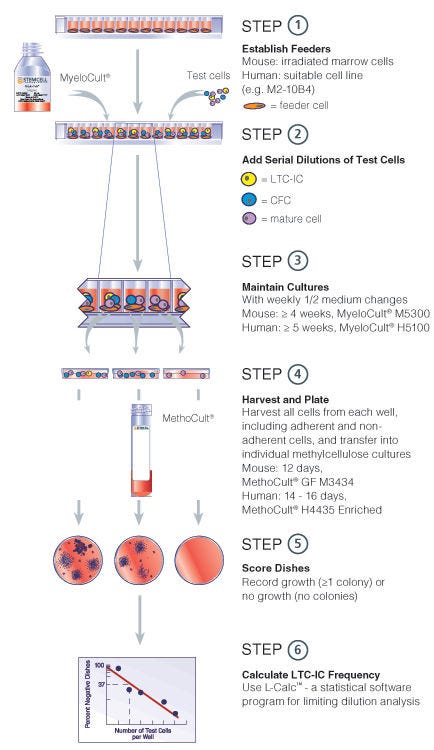
Limiting dilution LTC-IC assay

Figure 1. Limiting dilution LTC-IC assay

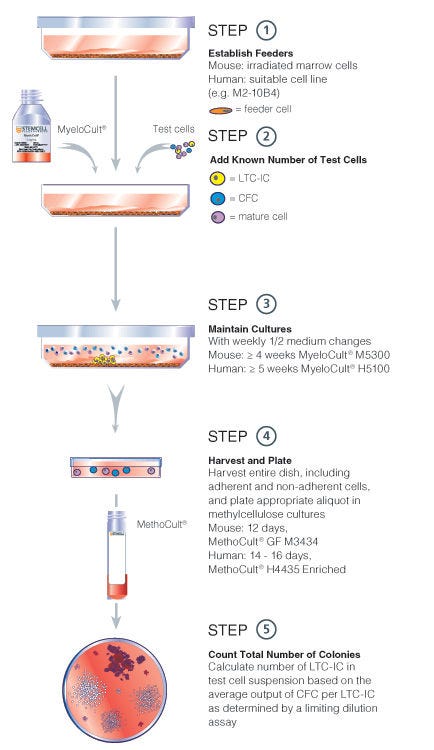
Bulk culture LTC-IC assay

Figure 2. Bulk culture LTC-IC assay

Protocols and Documentation

Find supporting information and directions for use in the Product Information Sheet or explore additional protocols below.

Document Type
Product Name
Catalog #
Lot #
Language
Catalog #
05150
Lot #
All
Language
English
Document Type
Technical Manual 1
Catalog #
05100
Lot #
All
Language
English
Document Type
Technical Manual 2
Catalog #
05100
Lot #
All
Language
English
Document Type
Safety Data Sheet
Catalog #
05150
Lot #
All
Language
English

Applications

This product is designed for use in the following research area(s) as part of the highlighted workflow stage(s). Explore these workflows to learn more about the other products we offer to support each research area.

Resources and Publications

Publications (83)

Transcriptional landscape of direct reprogramming toward the hematopoietic lineage. J. Cwycyshyn et al. iScience 2026 Sep

Abstract

Direct reprogramming of human fibroblasts into hematopoietic stem cells (HSCs) offers a promising strategy for generating autologous cells to treat blood and immune disorders. Current protocols are limited by low efficiency and insufficient tools for evaluating reprogramming outcomes. Although functional assays are the standard for confirming cell identity, they require fully reprogrammed cells, limiting their utility during protocol development. To address this, we assembled a single-cell transcriptomic reference atlas of hematopoietic reprogramming and tested an algorithmically predicted transcription factor recipe for HSC induction. Long-read single-cell RNA sequencing of CD34+ reprogrammed cells revealed progressive loss of fibroblast identity alongside induction of early hematopoietic and endothelial programs, with reference-atlas benchmarking placing reprogrammed cells in an intermediate transcriptomic state between fibroblasts, endothelial cells, and HSCs. Isoform-level analysis further revealed transcriptional remodeling not captured by gene-level analyses. This experimental-computational framework offers a generalizable strategy for characterizing partially reprogrammed states and guiding optimization of reprogramming protocols.
Dpep, a Cell-Penetrating Peptide Targeting ATF5, CEBPB and CEBPD, Synergistically Combines with ABT-263 and Decitabine to Inhibit Cancer Cell Growth and Overcome Dpep Resistance Q. Zhou et al. Cells 2026 May

Abstract

Dpep is a cell-penetrating peptide that targets transcription factors ATF5, CEBPB and CEBPD to selectively suppress growth and survival of diverse tumor cell types in vitro and in vivo. Due to these actions and its apparent safety, the peptide has potential as a cancer therapeutic. How Dpep might be combined with other anti-cancer agents to achieve synergistic efficacy and to overcome possible peptide resistance has not been assessed in depth. Based on prior work indicating that Dpep promotes apoptotic cancer cell death and up-regulates multiple pro-apoptotic and tumor suppressor genes, we studied combinations of Dpep with ABT-263, a pro-apoptotic BCL2 family inhibitor, and decitabine, a hypomethylating drug. Combining Dpep with each agent alone or together synergistically suppressed the growth of a range of solid and liquid tumor cell types. Moreover, the combinations synergistically inhibited the growth of cells lines that were selected either in vivo or in vitro for Dpep resistance. Finally, we tested the combination of Dpep with ABT-263 in a mouse melanoma xenograft model. The combination more effectively inhibited tumor growth than either agent alone and, in contrast to vehicle or ABT-263, produced a 40% durable survival rate. Taken together, these observations highlight potential drug partners for the therapeutic development of Dpep.
Selective agonists of KIR and NKG2A to evade missing self response of natural killer cells S. Hiura et al. Scientific Reports 2025 Sep

Abstract

Immune rejection is one of the most serious challenges in allogeneic transplantation, including allogeneic induced pluripotent stem cell (allo-iPSC)-derived cell therapy. Beta-2-Microglobulin gene-knockout, human leukocyte antigen (HLA) class I-deficient iPSCs can evade immune rejection by host T cells, which occurs due to HLA mismatches. However, natural killer (NK) cells recognize HLA class Ⅰ-deficient cells and reject them, which is known as the missing-self response. Introducing chimeric HLA-E protein to HLA class Ⅰ-deficient iPSCs suppresses the missing-self response of NK cells expressing the inhibitory receptor NKG2A; however, technology to suppress NKG2A-negative NK cells is still required. Here, we developed novel agonists for the other inhibitory receptor, killer immunoglobulin receptor (KIR), on NK cells. We found that antibodies that bind to activating KIR enhance NK cell activation and developed selective agonists for inhibitory KIRs (KIR2DL1, KIR2DL2/3, and KIR3DL1). Introducing these selective inhibitory KIR agonists on T cells and HLA class Ⅰ-deficient iPSCs allowed them to evade immune rejection by NK cells. Additionally, we identified an NKG2A-selective agonist as an alternative to chimeric HLA-E, which stimulates the activating receptor NKG2C. This technology enhances immune tolerance in allo-iPSCs and facilitates the development of various iPSC-derived regenerative medicines. The online version contains supplementary material available at 10.1038/s41598-025-18394-z. Subject terms: Allotransplantation, NK cells