NeuroCult® Proliferation Kit (Mouse)

? 1.800.667.0322   > Contact Us

Medium for Expansion of Mouse Neural Stem and Progenitor Cells


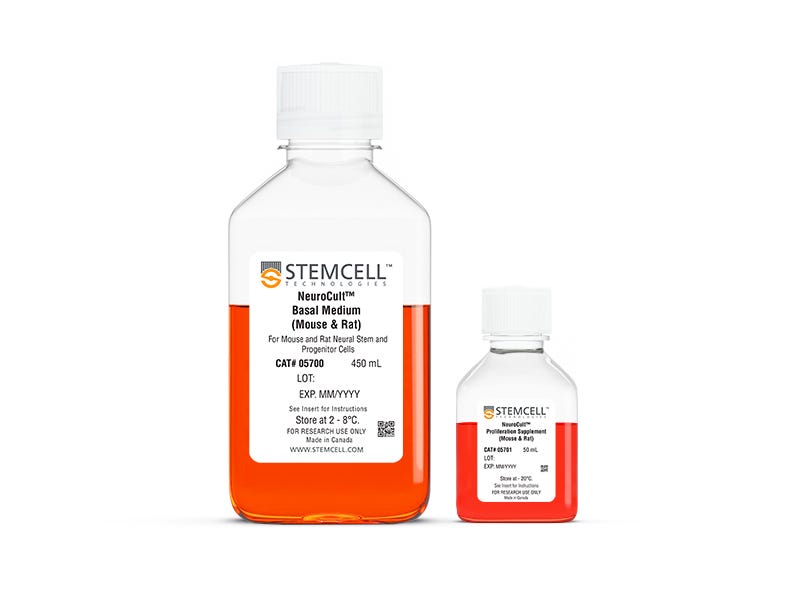
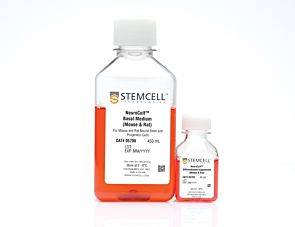
  • NeuroCult® Proliferation Kit (Mouse)
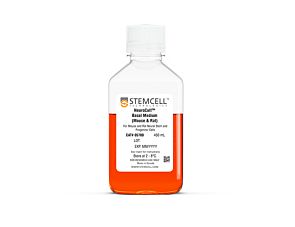
  • Label for NeuroCult® NSC Basal Medium (Mouse) 450 mL
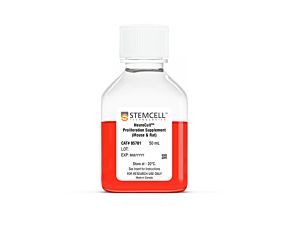
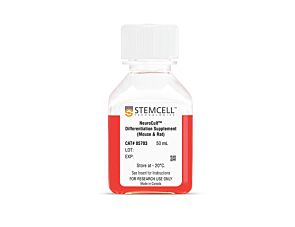
  • Label for NeuroCult® Neural Stem Cell Proliferation Supplement (Mouse) 50 mL
NeuroCult® Proliferation Kit (Mouse)
The NeuroCult® NSC Proliferation Kit (Mouse) is a standardized, serum-free medium for the culture of mouse neural stem and progenitor cells. The NeuroCult® NSC Proliferation Kit (Mouse) must be supplemented with appropriate cytokines (not included). When supplemented appropriately, the medium is optimized to maintain mouse neural stem cells in culture for extended periods of time without the loss of their self-renewal, proliferation or differentiation potential. The NeuroCult® NSC Proliferation Kit (Mouse) is comprised of NeuroCult® NSC Basal Medium (Mouse; Catalog #05700) and NeuroCult® NSC Proliferation Supplement (Mouse; Catalog #05701). Kit components are also available separately.
 
NOTE: When preparing Complete NeuroCult® Proliferation Medium (Mouse), addition of rh EGF (Catalog #02633) is required. When culturing cells obtained from adult mouse, rh bFGF (Catalog #02634) and heparin (Catalog #07980) are also required.
Product Name Description Catalog # Size Price Quantity
NeuroCult® Proliferation Kit (Mouse) Medium for expansion of mouse neural stem and progenitor cells 05702 1 Kit 158.00 USD      
 Save Item

Order Offline:

Call us: +1.604.877.0713  
Toll Free: 1.800.667.0322  
Email us:
 
Fax us: +1.604.877.0704
Toll Free Fax: 1.800.567.2899

Recommended for:
• Expansion of embryonic and adult mouse neural stem and progenitor cells as neurospheres or adherent monolayers
• Clonal and bulk isolation and propagation of embryonic and adult mouse neural stem and progenitor cells
• Note: When preparing Complete NeuroCult® Proliferation Medium (Mouse), addition of rh EGF (Catalog #02633) is required. When culturing cells obtained from adult mouse,  rh bFGF (Catalog #02634) and heparin (Catalog #07980) are also required
Components:
• NeuroCult® NSC Basal Medium (Mouse), 450 mL (Catalog #05700)
• NeuroCult® NSC Proliferation Supplement (Mouse), 50 mL (Catalog #05701)
Accessory Products:
• EGF, Human, Recombinant (Catalog #02633)
• bFGF, Human, Recombinant (Catalog #02634)
• Heparin (Catalog #07980)
Intended Use Statement: For Research Use Only. Not for Therapeutic or Diagnostic Use.
Contains:
N/A
Legal Statement: Sold under license from StemCells California, Inc. US Patent Nos. 5,750,376; 5,851,832; 5,980,885; 5,968,829; 5,981,165; 6,071,889; 6,093,531; 6,103,530; 6,165,783; 6,238,922.
Product Type: Specialized cell culture media
Application: Expansion
Area of Interest: Cancer, Neuroscience, Stem cell biology
Cell Type: Neural stem & progenitor cells
Medium Type: Serum-free, Liquid
Popular Product Line: NeuroCult
Species: Mouse

This product has been used in:

  1. Jana Vukovic et al. Microglia modulate hippocampal neural precursor activity in response to exercise and aging.J Neurosci 32 (19) 6435-6443 (May 9, 2012)
  2. Massimo Squatrito et al. Loss of ATM/Chk2/p53 Pathway Components Accelerates Tumor Development and Contributes to Radiation Resistance in Gliomas.Cancer Cell 18 (6) 619-629 (December 14, 2010)
  3. Hongwu Zheng et al. PLAGL2 regulates Wnt signaling to impede differentiation in neural stem cells and gliomas.Cancer Cell 17 (5) 497-509 (May 18, 2010)
  4. Areechun Sotthibundhu et al. Abeta(1-42) stimulates adult SVZ neurogenesis through the p75 neurotrophin receptor.Neurobiol Aging 30 (12) 1975-1985 (December 2009)
  5. Evan Elliott et al. BAG-1 is preferentially expressed in neuronal precursor cells of the adult mouse brain and regulates their proliferation in vitro.FEBS Lett 583 (1) 229-234 (January 5, 2009)
  6. Celine Mathieu et al. Endothelial cell-derived bone morphogenetic proteins control proliferation of neural stem/progenitor cells.Molecular and cellular neurosciences 38 (4) 569-577 (August 2008)
  7. Yun Li et al. TrkB regulates hippocampal neurogenesis and governs sensitivity to antidepressive treatment.Neuron 59 (3) 399-412 (August 14, 2008)
  8. Zeng-Jie Yang et al. Medulloblastoma can be initiated by deletion of Patched in lineage-restricted progenitors or stem cells.Cancer Cell 14 (2) 135-145 (August 12, 2008)
  9. Sharon A Louis et al. Enumeration of neural stem and progenitor cells in the neural colony-forming cell assay.Stem Cells 26 (4) 988-996 (April 2008)
  10. Yoko Ishii et al. Characterization of neuroprogenitor cells expressing the PDGF beta-receptor within the subventricular zone of postnatal mice.Mol Cell Neurosci 37 (3) 507-518 (March 2008)
  11. Karine Sii-Felice et al. Fanconi DNA repair pathway is required for survival and long-term maintenance of neural progenitors.EMBO J 27 (5) 770-781 (March 5, 2008)
  12. Kaylene M Young et al. Subventricular zone stem cells are heterogeneous with respect to their embryonic origins and neurogenic fates in the adult olfactory bulb.J Neurosci 27 (31) 8286-8296 (August 1, 2007)
  13. Eiji Mizutani et al. Developmental ability of cloned embryos from neural stem cells.Reproduction 132 (6) 849-857 (December 2006)
  14. Sung-Jo Kim et al. Palmitoyl-protein thioesterase-1 deficiency leads to the activation of caspase-9 and contributes to rapid neurodegeneration in INCL.Hum Mol Genet 15 (10) 1580-1586 (May 15, 2006)
  15. Jun Udagawa et al. The role of leptin in the development of the cerebral cortex in mouse embryos.Endocrinology 147 (2) 647-658 (February 2006)
  16. Turhan Coksaygan et al. Neurogenesis in Talpha-1 tubulin transgenic mice during development and after injury.Exp Neurol 197 (2) 475-485 (February 2006)
  17. Satoshi Kishigami et al. Significant improvement of mouse cloning technique by treatment with trichostatin A after somatic nuclear transfer.Biochem Biophys Res Commun 340 (1) 183-189 (February 3, 2006)
  18. Toshiyuki Ohtsuka et al. Visualization of embryonic neural stem cells using Hes promoters in transgenic mice.Mol Cell Neurosci 31 (1) 109-122 (January 2006)
  19. M Kucia et al. Cells enriched in markers of neural tissue-committed stem cells reside in the bone marrow and are mobilized into the peripheral blood following stroke.Leukemia 20 (1) 18-28 (January 2006)
  20. Zhongjian Zhang et al. Palmitoyl-protein thioesterase-1 deficiency mediates the activation of the unfolded protein response and neuronal apoptosis in INCL.Hum Mol Genet 15 (2) 337-346 (January 15, 2006)
  21. Viviane El-Helou et al. Resident nestin+ neural-like cells and fibers are detected in normal and damaged rat myocardium.Hypertension 46 (5) 1219-1225 (November 2005)
  22. Natalie D Bull et al. The adult mouse hippocampal progenitor is neurogenic but not a stem cell.J Neurosci 25 (47) 10815-10821 (November 23, 2005)
  23. Pasan Fernando et al. Neural stem cell differentiation is dependent upon endogenous caspase 3 activity.FASEB J 19 (12) 1671-1673 (October 2005)
  24. Christine Y Brazel et al. Sox2 expression defines a heterogeneous population of neurosphere-forming cells in the adult murine brain.Aging Cell 4 (4) 197-207 (August 2005)
  25. M Kucia et al. Bone marrow as a home of heterogenous populations of nonhematopoietic stem cells.Leukemia 19 (7) 1118-1127 (July 2005)

Background References:

  1. B A Reynolds et al. Clonal and population analyses demonstrate that an EGF-responsive mammalian embryonic CNS precursor is a stem cell.Dev Biol 175 (1) 1-13 (April 10, 1996)

Product Name

Description

Catalog #

NeuroCult® Differentiation Kit (Mouse) Medium for Differentiation of Mouse Neural Stem and Progenitor Cells 05704
Mouse Striata E14 Neurospheres Cryopreserved Passage 1 Neurospheres from Embryonic Mouse Striatal Tissue 00330
Mouse Cortex E14 Neurospheres Cryopreserved Passage 1 Neurospheres from Embryonic Mouse Cortical Tissue 00331
Mouse Ventral Mesencephalon E14 Neurospheres Cryopreserved Passage 1 Neurospheres from Embryonic Mouse Ventral Mesencephalon Tissue 00332
NeuroCult® NCFC Assay Kit (Mouse)
Assay to Quantify Neural Stem and Progenitor Cells
05740
NeuroCult® Enzymatic Dissociation Kit for Adult CNS Tissue (Mouse and Rat) Kit for Enzymatic Dissociation of Adult Mouse and Rat CNS Tissue 05715
NeuroCult® Chemical Dissociation Kit (Mouse) Kit for Chemical Dissociation of Mouse Neurospheres 05707
ALDEFLUOR™ Kit ALDEFLUOR™ Kit for the Identification, Evaluation and Isolation of Stem and Progenitor Cells Expressing High Levels of ALDH 01700
0.2% Heparin Sodium Salt in PBS 0.2% Heparin Sodium Salt in Phosphate Buffered Saline 07980
EGF, Human, Recombinant Epidermal Growth Factor 02633

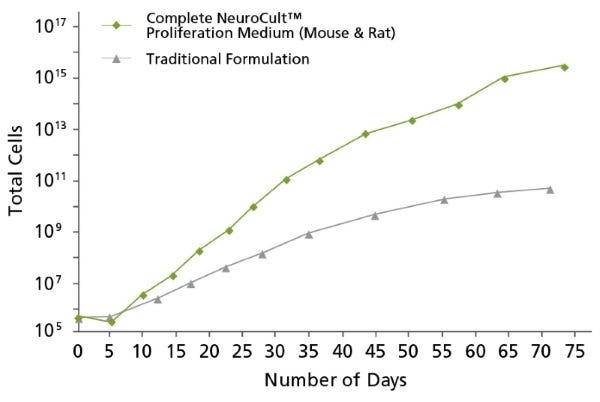
Comparison of cell expansion for mouse neurospheres cultured with Complete NeuroCult® Proliferation Medium (Mouse) or a traditional formulation


Comparison of cell expansion for mouse neurospheres cultured with Complete NeuroCult® Proliferation Medium (Mouse) or a traditional formulation
Cells microdissected from the cortices of E14 mice were cultured in Complete NeuroCult® Proliferation Medium (Mouse) or a traditional formulation containing 20 ng/mL rh EGF. At Day 71, cells cultured in Complete NeuroCult® Proliferation Medium (Mouse) were at Passage 13 while cells cultured in a traditional medium formulation were at Passage 10. Complete NeuroCult® Proliferation Medium (Mouse) consists of NeuroCult® NSC Basal Medium (Mouse), NeuroCult® NSC Proliferation Supplements (Mouse) and 20 ng/mL rh EGF.