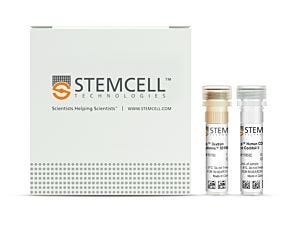
EasySep® Human CD4+ T Cell Enrichment Kit

? 1.800.667.0322   > Contact Us

Immunomagnetic Negative Selection Kit


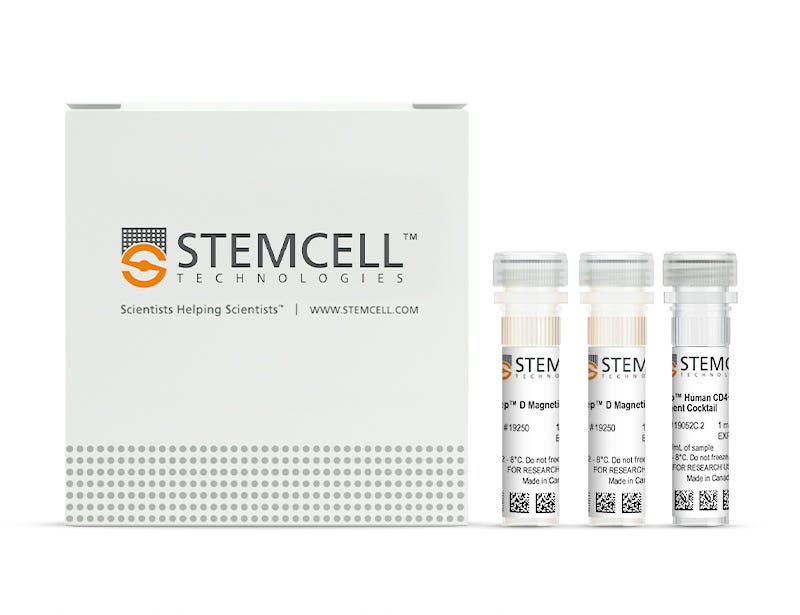
  • EasySep® box
  • Box top label for Human CD4+ T Cell Enrichment Kit For labeling 10e9 cells
EasySep® box
The EasySep® Human CD4+ T Cell Enrichment Kit is designed to isolate CD4+ T cells from fresh or previously frozen peripheral mononuclear cells by negative selection. Unwanted cells are targeted for removal with Tetrameric Antibody Complexes recognizing CD8, CD14, CD16, CD19, CD20, CD36, CD56, CD66b, CD123, TCRγ/δ, glycophorin A and dextran-coated magnetic particles. Labeled cells are separated using an EasySep® magnet without the use of columns. Desired cells are poured off into a new tube.
Product Name Description Catalog # Size Price Quantity
EasySep® Human CD4+ T Cell Enrichment Kit Immunomagnetic isolation of untouched human CD4+ T cells 19052 For labeling up to 1 x 10e9 cells 668.00 USD      
 Save Item
RoboSep® Human CD4+ T Cell Enrichment Kit with Filter Tips EasySep® kit with RoboSep® buffer and RoboSep® filter tips 19052RF For labeling up to 1 x 10e9 cells 702.00 USD      
 Save Item

Order Offline:

Call us: +1.604.877.0713  
Toll Free: 1.800.667.0322  
Email us:
 
Fax us: +1.604.877.0704
Toll Free Fax: 1.800.567.2899

Recommended for:
The isolation of human CD4+ T cells from fresh or previously frozen peripheral blood mononuclear cells by negative selection
Components:
• EasySep® Human CD4+ T Cell Enrichment Cocktail, 1.0 mL
• EasySep® Magnetic Particles, 2 x 1.0 mL
Intended Use Statement: For Research Use Only. Not for Therapeutic or Diagnostic Use.
Equipment Required:
• EasySep® Magnet (Catalog #18000), or
• “The Big Easy” EasySep® Magnet (Catalog #18001), or
• "Easy 50" EasySep® Magnet (Catalog #18002), or
• RoboSep® (Catalog #20000)
Product Type: Cell isolation products
Area of Interest: HIV, Immunology
Cell Isolation Product Type: Reagents
Cell Source: Leukapheresis, PBMC
Cell Type: CD4+ T cells, T cells
Popular Product Line: EasySep, RoboSep
Selection Method: Negative
Species: Human

Procedures and instruction manuals:

Educational resources:

MSDS:

FAQS:


  • HOW EASYSEP™ WORKS

    • Q. CAN EASYSEP™ BE USED FOR EITHER POSITIVE OR NEGATIVE SELECTION?
      A. Yes. The EasySep™ kits use either a negative selection approach by targeting and removing unwanted cells or a positive selection approach targeting desired cells. Depletion kits are also available for the removal of cells with a specific undesired marker (e.g. GlyA).
    • Q. HOW DOES THE SEPARATION WORK?
      A. Magnetic particles are crosslinked to cells using Tetrameric Antibody Complexes (TAC). When placed in the EasySep™ Magnet, labeled cells migrate to the wall of the tube. The unlabeled cells are then poured off into a separate fraction.
    • Q. WHICH COLUMNS DO I USE?
      A. The EasySep™ procedure is column-free. That's right - no columns!
    • Q. HOW CAN I ANALYZE THE PURITY OF MY ENRICHED SAMPLE?
      A. The Product Information Sheet provided with each EasySep™ kit contains detailed staining information.
    • Q. CAN EASYSEP™ SEPARATIONS BE AUTOMATED?
      A. Yes. RoboSep™, the fully automated cell separator, automates all EasySep™ labeling and cell separation steps.
    • Q. CAN EASYSEP™ BE USED TO ISOLATE RARE CELLS?
      A. Yes. We recommend a cell concentration of 2x10⁸ cells/mL and a minimum working volume of 100 µL. Samples containing 2x10⁷ cells or fewer should be suspended in 100 µL of buffer.

    EASYSEP™ MAGNETIC PARTICLES

    • Q. ARE THE EASYSEP™ MAGNETIC PARTICLES FACS-COMPATIBLE?
      A. Yes, the EasySep™ particles are flow cytometry-compatible, as they are very uniform in size and about 5000X smaller than other commercially available magnetic beads used with column-free systems.
    • Q. CAN THE EASYSEP™ MAGNETIC PARTICLES BE REMOVED AFTER ENRICHMENT?
      A. No, but due to the small size of these particles, they will not interfere with downstream applications.
    • Q. HOW DOES THE BINDING OF THE EASYSEP™ MAGNETIC PARTICLE AFFECT THE CELLS? IS THE FUNCTION OF POSITIVELY SELECTED CELLS ALTERED BY THE BOUND PARTICLES?
      A. Hundreds of publications have used cells selected with EasySep™ positive selection kits for functional studies. Our in-house experiments also confirm that selected cells are not functionally altered by the EasySep™ magnetic particles.

      If particle binding is a key concern, we offer two options for negative selection. The EasySep™ negative selection kits can isolate untouched cells with comparable purities, while RosetteSep™ can isolate untouched cells directly from whole blood without using particles or magnets.

    MODIFYING THE EASYSEP™ PROTOCOL

    • Q. CAN I ALTER THE SEPARATION TIME IN THE MAGNET?
      A. Yes; however, this may impact the kit's performance. The provided EasySep™ protocols have already been optimized to balance purity, recovery and time spent on the isolation.
    • Q. FOR POSITIVE SELECTION, CAN I PERFORM MORE THAN 3 SEPARATIONS TO INCREASE PURITY?
      A. Yes, the purity of targeted cells will increase with additional rounds of separations; however, cell recovery will decrease.

This product has been used in:

  1. Tae-Wook Chun et al. Rebound of plasma viremia following cessation of antiretroviral therapy despite profoundly low levels of HIV reservoir: implications for eradication.AIDS 24 (18) 2803-2808 (November 27, 2010)
  2. Stephanie M Dorosko et al. Primary human mammary epithelial cells endocytose HIV-1 and facilitate viral infection of CD4+ T lymphocytes.J. Virol. 84 (20) 10533-10542 (October 15, 2010)
  3. Juliette Diou et al. Dendritic cells derived from hemozoin-loaded monocytes display a partial maturation phenotype that promotes HIV-1 trans-infection of CD4+ T cells and virus replication.J Immunol 184 (6) 2899-2907 (March 15, 2010)
  4. Jonathan Richard et al. HIV-1 Vpr up-regulates expression of ligands for the activating NKG2D receptor and promotes NK cell-mediated killing.Blood 115 (7) 1354-1363 (February 18, 2010)
  5. Martin Pelletier et al. Evidence for a cross-talk between human neutrophils and Th17 cells.Blood 115 (2) 335-343 (January 14, 2010)
  6. Elena Zenaro et al. Induction of Th1/Th17 immune response by Mycobacterium tuberculosis: role of dectin-1, Mannose Receptor, and DC-SIGN.J Leukoc Biol 86 (6) 1393-1401 (December 2009)
  7. Piotr Trzonkowski et al. First-in-man clinical results of the treatment of patients with graft versus host disease with human ex vivo expanded CD4+CD25+CD127- T regulatory cells.Clin Immunol 133 (1) 22-26 (October 2009)
  8. Brian P. Doehle et al. Human immunodeficiency virus type 1 mediates global disruption of innate antiviral signaling and immune defenses within infected cells.J. Virol. 83 (20) 10395-10405 (October 15, 2009)
  9. Michael L Vetter et al. Cytoplasmic APOBEC3G restricts incoming Vif-positive human immunodeficiency virus type 1 and increases two-long terminal repeat circle formation in activated T-helper-subtype cells.J Virol 83 (17) 8646-8654 (September 2009)
  10. R. Brad Jones et al. HIV-1 escapes from IL-2-producing CD4+ T cell responses without high-frequency fixation of mutationsJ. Virol. JVI.00433-09 (June 24, 2009)
  11. Patrizia Fuschiotti et al. Effector CD8+ T cells in systemic sclerosis patients produce abnormally high levels of interleukin-13 associated with increased skin fibrosis.Arthritis Rheum 60 (4) 1119-1128 (April 2009)
  12. Piotr Trzonkowski et al. Ex vivo expansion of CD4(+)CD25(+) T regulatory cells for immunosuppressive therapy.Cytometry A 75 (3) 175-188 (March 2009)
  13. Rita I Azevedo et al. IL-7 sustains CD31 expression in human naive CD4+ T cells and preferentially expands the CD31+ subset in a PI3K-dependent manner.Blood 113 (13) 2999-3007 (March 26, 2009)
  14. Marina Saresella et al. CD4+CD25+FoxP3+PD1- regulatory T cells in acute and stable relapsing-remitting multiple sclerosis and their modulation by therapy.FASEB J 22 (10) 3500-3508 (October 2008)
  15. Manuela Fogli et al. Lysis of endogenously infected CD4+ T cell blasts by rIL-2 activated autologous natural killer cells from HIV-infected viremic individuals.PLoS Pathog 4 (7) e1000101 (July 2008)
  16. Ravikumar Muthuswamy et al. Ability of mature dendritic cells to interact with regulatory T cells is imprinted during maturation.Cancer Res 68 (14) 5972-5978 (July 15, 2008)
  17. Alexandra Lambert et al. The C-type lectin surface receptor DCIR acts as a new attachment factor for HIV-1 in dendritic cells and contributes to trans- and cis-infection pathwaysBlood 112 (4) (June 9, 2008)
  18. James Arthos et al. HIV-1 envelope protein binds to and signals through integrin [alpha]4[beta]7, the gut mucosal homing receptor for peripheral T cellsNat Immunol advanced online publication (3) 301-309 (February 10, 2008)
  19. Angela J Fahey et al. Reciprocal effects of IFN-beta and IL-12 on STAT4 activation and cytokine induction in T cells.J Leukoc Biol 81 (6) 1562-1567 (June 2007)
  20. Genevieve Martin et al. Human immunodeficiency virus type 1-associated CD40 ligand transactivates B lymphocytes and promotes infection of CD4+ T cells.J. Virol. 81 (11) 5872-5881 (June 1, 2007)
  21. Caroline Gilbert et al. HIV-1 replication in dendritic cell/T-cell co-cultures is increased upon incorporation of host LFA-1 due to a higher virus productive infection in immature dendritic cellsJ. Virol. JVI.02810-06 (May 9, 2007)
  22. Melanie Wencker et al. Human T-cell leukemia virus type 1 Tax protein down-regulates pre-T-cell receptor alpha gene transcription in human immature thymocytes.Journal of virology 81 (1) 301-308 (January 2007)
  23. Paul J Peters et al. Non-macrophage-tropic human immunodeficiency virus type 1 R5 envelopes predominate in blood, lymph nodes, and semen: implications for transmission and pathogenesis.J Virol 80 (13) 6324-6332 (July 2006)
  24. Angelique Bellemare-Pelletier et al. HLA-DO transduced in human monocyte-derived dendritic cells modulates MHC class II antigen processingJ Leukoc Biol 78 (1) 95-105 (July 1, 2005)

Product Name

Description

Catalog #

CD4 Antibody, Clone L120, PE-Conjugated Mouse Monoclonal Antibody to Human CD4 - PE Conjugated 10435
CD4 Antibody, Clone L120, FITC-Conjugated Mouse Monoclonal Antibody to Human CD4 - FITC Conjugated 10434
Ficoll-Paque™ PLUS Density Gradient Medium for the Isolation of Mononuclear Cells 07907
EasySep® Magnet Immunomagnetic Column-Free Magnet 18000
The Big Easy EasySep® Magnet Immunomagnetic Column-Free Magnet 18001
Easy 50 EasySep® Magnet Immunomagnetic Column-Free Magnet 18002
RoboSep™ RoboSep™ - The Fully Automated Cell Separator 20000

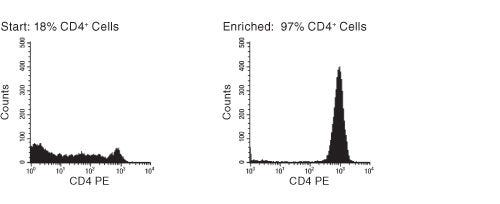
FACS Histogram Results Using EasySep® Human CD4+ T Cell Enrichment Kit


FACS Histogram Results Using EasySep® Human CD4+ T Cell Enrichment Kit
Starting with frozen mononuclear cells, the CD4+ T cell content of the enriched fraction typically ranges from 92% - 97%.


Typical EasySep® Procedure for Human Cells


Typical EasySep® Procedure for Human Cells